Saturday, October 25, 2014

Part II of III: Celebrating Retirement In A Most Fitting Fashion

A few years ago my father made the decision to retire from his profession.  He had worked tirelessly since his teens and wanted to scale back his work commitments.  He envisioned a more leisurely life of gardening and travel, punctuated by a healthy dose of grandfatherly antics with his adoring grandchildren, all of which sounds terribly exhausting, especially for a septuagenarian.

It was difficult for me to actually imagine him truly retiring from his craft, no longer to be surrounded by bolts of fine cloth, the ever present dusty mess of his tailoring chalk, and a seemingly endless trail of errant threads and misplaced needles.  But, retirement was firmly on his mind so he hung up his shears, dismantled his workshop, and entered into the next phase of his life.

Actually, it was not quite that simple.  Some very special projects came knocking at his door which culminated in a spectacular apotheosis to his lengthy career.

It all began early in 2011.  My father was approached with the idea of working on an item of clothing that would be photographed as part of a series of Royal Mail postage stamps commemorating the best of British Fashion.

He was charged with replicating a jacket he had originally tailored in the early 1970's for Ringo Starr of The Beatles.  The original was designed by Tommy Nutter and cut by his colleague Edward Sexton, a master at his craft.  As my father had tailored the 1970's version, he was the only tailor considered for the remake, and rightly so.

Chronica Domus
The nattily dressed Ringo Starr wearing the jacket my father tailored in the early 1970's, designed by the flamboyant Tommy Nutter


Make no mistake, this was no ordinary commission. The design incorporates a unique one-piece rolled collar that is highlighted with contrasting trim.  The sleeves, slightly upturned where they connect to the shoulder line, give the jacket an unusual silhouette. Only the most experienced of tailors would be able to successfully replicate the look of the original. The garment was more akin to a sculptural work of art than a piece of clothing.

Procuring the identical striking black and white Prince of Wales tweed to that of the original was next on the agenda.  Fortunately, the British mill that weaved the fabric in the 1970's is still in existence, but production of the pattern had long ago ceased. Apparently, very good records were kept because a little sleuthing through the mill's archives unearthed an adequate sample allowing the weavers to replicate the cloth especially for the stamp project.

I was intrigued to see the final result of this unusual collaboration with the Royal Mail. Fittingly, the stamp would be issued in the spring of 2012, just as my father was about to retire. Would you believe it if I told you he only shared the news of the stamp commission with me in passing, as though he was relaying a trivial tidbit of neighborhood gossip over the garden fence?  It was the eve of my departure from London, having visited with my parents during the prior three weeks of my winter holiday. Over cups of tea seated around the old pine kitchen table, he told me the story.  I'm so happy he did as it gave me the opportunity to put in my order for a first day special issue set of stamps that would be canceled at a post office located in W1, the same central London postcode shared by Savile Row, using a special ink stamp to commemorate the occasion.  The word proud falls vastly short of how I felt the day I received my stamps.

Chronica Domus
The replica jacket my father tailored as shown on the first class Royal Mail stamp


My colorful first day issue cover of the complete set of British fashion stamps
Photo: Chronica Domus

I just love the special needle and thread spool ink stamp designed especially to cancel the first day issue covers
Photo: Chronica Domus

During the same conversation at the kitchen table that evening, my father relayed another bit of exciting news.  He casually mentioned the fact that he had been asked to give a talk on the opening day of a spacial exhibit that had been shown several months earlier at London's Fashion and Textile Museum.  Sadly, he had politely declined the invitation. "What?" I spurted, almost spilling my tea everywhere.  To make matters worse, I wondered why it was that I was only now learning of this news after the exhibition had closed. My father, as it turned out, did not think it "a big deal".

Chronica Domus
An advertisement for the Tommy Nutter: Rebel On The Row exhibition

Actually, it was. Titled Rebel On The Row, the exhibition showcased many of the suits my father had tailored during the heyday of his career working at Nutters. It told the story of how Tommy Nutter revolutionized British tailoring.  I could barely believe my father's nonchalance towards this very exciting event. Suits he had tailored such as Mick and Bianca Jagger's wedding outfits, Elton John's colorful moire tailcoats, along with many other distinctive examples, were among the stars of this exhibit, and my father had made them all.

Chronica Domus
Mick and Bianca Jagger on their wedding day wearing the jackets my father tailored while working at Nutters (note: Bianca began the trend for cleavage-bearing attire decades before the likes of Jennifer Lopez and every other female celebrity caught on)


Chronica Domus
Two of the many memorable tailcoats I watched my father make for Elton John's 1984 "I'm Still Standing" tour


I suppose his relaxed attitude should not have come as such a great surprise.  My father has always shied away from the spotlight and self-promotion, preferring instead to take pleasure in his work from behind the scenes.  I truly wish I could have seen this event firsthand to revisit some of my father's most memorable work.

The final jacket of my father's long career was to be worn at a very distinguished milestone celebration. Queen Elizabeth II would be celebrating her diamond jubilee throughout 2012.  To mark the auspicious occasion, a festive pop concert was to be staged directly in front of Buckingham Palace. Many of Britain's biggest musical talents would take the stage to entertain Her Royal Highness and other members of the royal family.  My father had been asked to make a particularly special jacket for one of the entertainers to be worn during the evening's grand performance.

The design, resembling a vintage British Bobby's jacket, would have a little decorated stand up collar and cuffs, and be set off with shiny silver metal buttons shaped into coronets. When my father took delivery of the cloth to be used for the jacket, which had been dropped off at his workshop by runner in a nondescript heavy-duty paper bag, he noticed it contained more than the expected bundle of pre-cut cloth.  He was a little bemused to discover a bedraggled vintage Union Jack flag which, upon closer examination, revealed it had formed part of a moth's banquet.  It was riddled with tiny holes. The flag turned out to be a 1953 model, manufactured the same year of Queen Elizabeth II's coronation.  I'll return to the flag a little later in the story.

On June 4, 2012, the day of the diamond jubilee concert celebration, we all eagerly awaited the appearance of Paul McCartney, not for his noted singing abilities mind you, but for the sheer pleasure of ogling at the jacket my father had made for him.

Chronica Domus
Performing on stage for Her Royal Highness and millions of viewers around the world during the diamond jubilee concert celebration


Riveted to the television screen, we were more than a little delighted when, at the conclusion of his performance, Sir Paul whipped off his jacket and flashed his 1953 Union Jack to the world. Bravo Sir Paul, bravo! What a patriotic showman you are!

Chronica Domus
In glorious patriotic spirit Sir Paul flashes his vintage Union Jack which now forms the lining to his jacket


And with that, dear reader, my father's career had come to a glorious end, in front of millions of viewers across the world, upon a stage in front of Buckingham Palace and The Queen of England, in the most fitting British way.  I could not imagine a more memorable retirement celebration than this grand spectacle, can you?

Chronica Domus
I'm sure Her Majesty was suitably impressed with Sir Paul's patriotic sartorial flair

In the final installment to this series, I will show you what my father tailored for my lucky husband and I as his retirement gift to us.


Sunday, October 19, 2014

Part I of III: Birthday Wishes To My Father & How He Fell Into His Profession

Tomorrow is my father's birthday and as I've been thinking about him a lot lately, I decided to write a short series of posts all about his work.  Happy Birthday Daddy!

Chronica Domus
My beaming father at the age of sixteen wearing the first suit he ever made, a double-breasted example, photographed with his two adoring sisters
Photo: Chronica Domus


You've never met my father, but if you've ever seen Rex Harrison in the film My Fair Lady, or have admired or been equally amused at some of Elton John's unique and zany stage suits, or perhaps remember the cover of The Beatles album Abbey Road, you will likely have seen my father's handiwork. Until his retirement a few years ago, my father was a Savile Row tailor.

During his lengthy career, which began as an apprentice at the tender age of sixteen, when he was a mere rakish lad, he has dressed some of the most famous figures in the world. People from all walks of life that have admired and desired the fine cut of a bespoke suit have crossed paths with my father. His jackets have been worn by figures from the world of stage and screen, members of the royal families of Europe and the middle-east, politicians, singers of popular music and classical opera, captains of industry, and untold numbers of ladies and gentlemen whose taste in sartorial elegance includes a finely crafted suit.

Becoming a tailor was something that was quite unplanned for my father, and he was the only member of his immediate family to have pursued a creative career. I believe this is because he is an artist at his very core, someone for whom the smallest and most subtle detail can never escape his critical eye. He has nearly a sixth sense as to how cloth might be manipulated to drape and caress in just the right places, highlighting or even disguising the best or worst features of a person's frame. He can appreciate the construction of a tiny horn button, or the way a pair of scissor blades have been honed to cut just so, and whose weight balances perfectly in the hand. When I was a little girl, I remember him constantly doodling on the silver paper linings found within his packets of Rothmans cigarettes, often little crude designs of lapel styles or theatrical renditions of jackets and blazers.

I recall my father telling the story of how he was so all consumingly bored upon being given the tedious duty of gluing endless fabric samples into books, his sole responsibility at his first job. The operation was based in a multi-storey building somewhere in London, and he found it most amusing to pad out his day by riding the building's only elevator, up and down ad nauseum. Well, his superior soon clocked onto his game when other employees began complaining that the elevator was always jammed and out-of-service. I don't think that job lasted for too much longer.

Next, he managed to be taken under the wing of an experienced tailor as an apprentice, who soon taught him how to cut. My father likes to relay how he ruined Peter Sellers' jacket by cutting the fabric for the sleeves backwards. Poor daddy, he didn't even know his right from his left and there he was being given the heavy responsibility of cutting through costly Holland & Sherry worsteds and wools.  He remembers a swift clip around the ear being delivered with an admonishment to pay attention; measure twice and cut once, and all of that.

By the time his apprenticeship was completed, my father certainly knew his craft competently enough to have made Rex Harrison's suits in the 1964 film My Fair Lady. Examples of traditional English tailoring can be seen through the various tweeds and dinner jackets worn by the actor.

Chronica Domus
If you can get past the fountain spouting out of my father's head, you can see the young author of this blog (right) and her sister (left) enjoying a trip to Trafalgar Square, smartly attired in their first bespoke overcoats made by their talented father
Photo: Chronica Domus


My father eventually moved on to work for the suiting department at Harrods where he made ladies bespoke clothing. Jackets, skirts, and simple shift dresses were very popular items among the fairer sex.  I recall my mother showing me a fabulous shift dress in deep red wool, with a matching cropped and collared jacket adorned with shiny brass buttons that he had made for her around the time he was dressing some of the wealthiest women in London.  Imagine having your very own personal tailor at your disposal.  My mother always looked fabulously elegant at social functions thanks to my father's creations. My sister and I also benefited from his craft. One of my very favorite childhood photographs was snapped in Trafalgar Square where we were taken often to feed the pigeons. Not only do I cherish this photograph because of the happy memories, but also because the little coats my sister and I are wearing were made by my father.  If you look carefully, the very bottom button of our coats remains unfastened not because we were careless at dressing ourselves for our outing, but for the simple fact that my father was a tailor, and tailors have particular ways of doing things. Who knew there was a code of what buttons to fasten and which to leave unbuttoned. Apparently, this was the correct way to wear one's double-breasted coat. Of course, my father also made the heavy overcoat he sports too in the photograph.

Chronica Domus
My favorite photograph of Tommy Nutter, whom I consider to have been one of the 20th century's most elegant dandies


In 1969, one of Savile Row's most colorful characters offered my father a tailoring position. Tommy Nutter was unlike any other tailor on the row. He was flamboyant and larger than life, a gentleman peacock, and a true original.  He completely tore away from the traditional conservative ideal of what a bespoke suit should look like, the type of British cut that had placed Savile Row on the world's map. Thinking about this over forty years later, I can see exactly why my father, a tearaway rebel in his own right, went to work for Mr. Nutter, who was eventually nicknamed The Rebel On The Row, a dandy not seen since the days of Beau Brummell. It was to be a natural fit for my father, and he enjoyed the work there immensely.

Here my father crafted some of the era's wildest and most colorful and innovatively cut suits. Nutters attracted the glitterati of the day unlike any other traditional tailoring firm before it. Suddenly, stars such as Elton John, The Rolling Stones, and The Beatles all wanted to be dressed by Tommy Nutter.

Eventually, Nutters began making ready-to-wear lines and fewer bespoke suits so my father went on to work for various other firms along the row including Edward Sexton, Chittleborough & Morgan, and lastly, Gieves & Hawkes, tailors to the British royals.

Just before his retirement a few years ago, something quite marvelous happened. I shall leave that little story for my next post.

I do hope you'll come back and read the next installment to this series.

Sunday, October 12, 2014

A is for Pie ...

... apple pie, that is.  I've been quite a busy bee this past week baking to my heart's content. The house has been filled with the comforting nostalgic smells of homemade apple pie, wafting from the hot kitchen oven and perfuming the air. It is a smell I associate deeply with the months of autumn. Making these pies is like an annual rite of passage, heralding the cooler autumnal months ahead. 

This year, I got a little ahead of myself as I rushed into pie making on one of the hottest days of the year. The mercury had climbed to almost 100 degrees Fahrenheit, turning my kitchen into a tropical hothouse, which is certainly not an ideal or pleasant environment when the ovens are all fired up. Indian summer had arrived right on cue, and with a vengeance. I am happy to report that unlike recent years, the heat subsided within a week and things returned to their seasonal normalcy, which is just dandy with me. The grey misty morning autumn skies I enjoy are back, hooray!

My favorite vintage pastry tools; a turned wood rolling pin and a pastry jagger or wheel
Photo: Chronica Domus


I believe I have baked more apple pies than any other fruit pie.  My family enjoys them exceedingly. Come to think of it, I've yet to encounter anyone with a dislike of apple pie, have you?  Pies are an uncomplicated sweet treat, to be shared with one's family and friends following a satisfying meal, or during an afternoon tea or coffee break. Homemade pies are rarely turned down when offered by the slice.  They really are rather irresistible, even to those who feign their slenderization diet shall be set to ruin. I always make my own pastry, and use the same old wooden tools to shape the dough; an old turned wood rolling pin, and a handsome little wooden pastry jagger or wheel. I own one other rolling pin that I press into service too, a hefty French pastry baton, which was a gift from a favorite uncle. 

The first pie I made this autumn put to use some of the apples we recently harvested from our trees. Once I peeled the various unidentified apples, and added a little sugar, a pinch of cinnamon, and a grating or two of nutmeg, I heaped the fruit into the chilled pastry shell and took a moment to admire its rustic beauty. The apples really looked marvelous glistening in their juices. They ranged from creamy yellow to pale green in color.

Homegrown apples heaped into a homemade pastry shell
Photo: Chronica Domus


I chose to decorate the top of the pie in what I consider to be the quintessential American pie style. I formed the pastry into strips using my little wooden jagger.

A favorite vintage pastry jagger makes the job of pastry cutting a breeze
Photo: Chronica Domus


I then interlaced the pastry strips into a basket-weave or lattice design, glazed the top in an egg and cream wash, and sprinkled a touch more sugar across the surface. The pie was then ready for my oven.

The basket-weave pastry topped pie awaits baking
Photo: Chronica Domus


Wouldn't you agree that the lattice topping is the definitive picture of old-fashioned American apple pie?  I do not overly sweeten the fruit, nor over perfume it with spices and flavorings, at least when compared to most of the store purchased examples I have tried. The spotlight shines firmly on the apples, just as it should.

The baked pie cooling and almost ready for devouring
Photo: Chronica Domus


As my husband is American, he prefers his pie served à la mode, with scoops of vanilla ice cream. We Brits do things rather differently, or at least did when I was growing up. If drizzling one's pie with thick hot custard is not to your liking, cold double cream, or heavy whipping cream as it is known in America, is the preferred accompaniment to a slice of pie.  Interestingly, my American born daughter enthusiastically subscribes to the British way of doing things and positively drowns her pie in cream, lapping it all down before sheepishly asking for more; a modern day Oliver Twist in the making.

Can you guess which plate is mine?
Photo: Chronica Domus


Of course, a slab of mature Cheddar cheese is another option to consider as accompaniment to apple pie, but lifelong habits are hard to break and I always prefer mine with lashings of decadent cream.

The second pie I baked this past week was also made of unidentified apples. I've been patiently watching a nearby tree in our neighborhood through evening jaunts with my trusty canine companion. It is absolutely groaning with bright green fruits that resemble my favorite cooking apple, Granny Smith.   


I love the mustard yellow color of American 19th century yellow ware against the vivid green of the unidentified neighborhood apples
Photo: Chronica Domus


The neighborhood tree was ripe for picking last week so I helped myself to a bowlful of the green orbs with plans to recreate a traditional English apple pie. In England, one would, of course, opt to use the king of cooking apples, the puckeringly tart Bramley. Try as I might, I have failed miserably in my attempts at getting my little pie making hands on Bramley apples since moving to California.

Upon peeling the fruits, I noticed a remarkable green tone to their flesh, which suggested these might well be Granny Smiths. It seemed I was dealing with the venerable green ladies after all. I pressed on with the addition of an appropriate and limited amount of sugar to preserve the tartness we so enjoy in our pies, and a delicate grating of nutmeg.

Notice how green the apples appear unlike my home-grown apples
Photo: Chronica Domus


Traditional English apple pies tend to be made with a round of pastry capping the fruit.  A simple but pretty design is formed with the aid of the sharp blade of a paring knife. Not only is this an attractive decoration for the pastry, it also helps vent the steam formed while the apples are baking.

My version of traditional English apple pie ready for baking
Photo: Chronica Domus


Forty-five minutes later, my timer was abuzz, nudging me to remove the pie from the heat of the oven.   Its golden brown pastry and thickened bubbling juices around the vent holes were my cues that this pie was well and truly baked.  It looks delicious, wouldn't you agree?

Mmmm ...the tempting sight of a freshly baked pie fresh from the oven
Photo: Chronica Domus


Care for a piece of pie?
Photo: Chronica Domus

The vivid green neighborhood tree apples have baked down to an almost thick saucy consistency, much in the way of English Bramley cooking apples.  The taste is sharp and tart, again reminiscent of traditional English pies.  I was chuffed to bits at the success of my experiment, and boy was it scrumptious. Now, if only I knew the identity of these apples. I really don't believe they are Granny Smiths as those seem to hold their shape when cooked.  Ah, the complexities of pomology can be quite befuddling at times. 

As we sat chatting about who liked which pie, we all came to the conclusion that our homegrown apples were far better suited to eating than baking.  Yes, they made for a decent pie filling to be sure, but as their flavor was superior to those apples we are able to purchase from the market, they really were wasted when baked in a pie. On the other hand, the unidentified green neighborhood apples, whose zippy tart taste we enjoyed, were a hit in the flavor department, but not such a favorite for their sauce-like texture.  I personally enjoyed the baked-down filling but majority tends to rule in this household so I'll be back to baking with Granny Smiths again.

Do you enjoy eating and baking apple pies during the months of autumn, and what constitutes a tasty pie for you?  

Monday, October 6, 2014

Home At Last: The Reopening of Chuck Williams' First Shop

Chronica Domus
Home at last: A sign announcing the reopening of Chuck Williams' first shop in Sonoma, California, originally opened from 1956 to 1958
Photo: Chronica Domus


For any of my American and Canadian readers that have an interest in home cooking, they would have at some point in the past half century darkened the doors of America's premier culinary supply mecca, Williams-Sonoma. The company, whose stores are to be found in most metropolitan areas, stock a range of high-quality cookware and bakeware. One can find every conceivable piece of equipment required to build a batterie de cuisine to rival that of Antoine Carême.

The founder, Charles Williams, or Chuck as he likes to be called, was responsible for introducing American cooks to the finest, most practical and beautiful kitchen equipment, discovered on his travels as a young lad in Europe.

Mr. Williams opened his first shop in 1956 in the small wine country town of Sonoma, California. Initially, he sold only hardware but soon transformed the shop into a cook's paradise, stocking classic French kitchen equipment not found elsewhere. The emporium rapidly became a roaring success with a loyal following of enthusiastic home cooks and professional chefs alike. It soon became apparent that if the business was to further expand and continue showcasing the quality cookware Mr. Williams was introducing to the American market, he would have to relocate his shop to the big city. So, after two short years, the little shop in Sonoma was shuttered, reopening at its new location in the heart of San Francisco's shopping district. The rest, as they say, is history.

Chronica Domus
The original Williams-Sonoma shopfront, seen above at left, as it appeared between 1956 and 1958

Chronica Domus
The shopfront as photographed on Saturday, October 4, 2014 during the re-opening celebrations
Photo: Chronica Domus


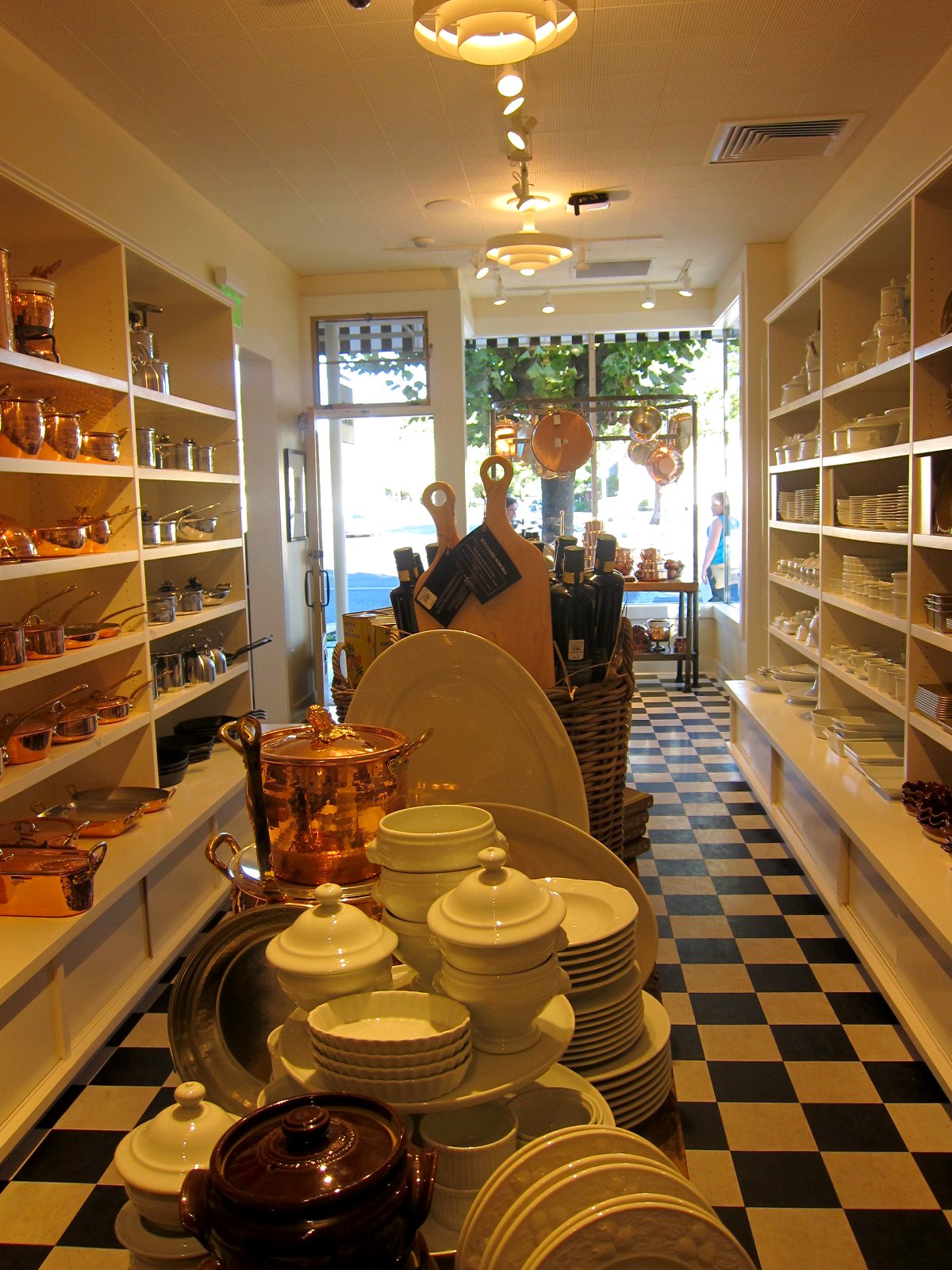
This past Saturday, Mr. Williams came home again. In celebration of his ninety-ninth birthday, the original Sonoma outpost was reopened to great fanfare, fifty-six years since it closed its doors. The Broadway Street location has been remodeled almost exactly as it appeared in 1958, with its simple white open shelving and classic black and white checkered flooring. Even the original shop sign has been reinstated and hangs proudly outside under the smart striped awning.

I say "almost exactly as it appeared" because the store has now expanded to fill the entire building and is divided into two parts; the original small shop front in replica form to the original, and the new addition of a cooking school off to the side. Mr. Williams' house, situated directly behind his shop, and which he once shared with his mother, has also been incorporated into the retail experience. Today, one can walk freely between the shop floor and the house, which has been restored and showcases the company's home goods. Mr. Williams' bedroom and office have been recreated, as has his private kitchen downstairs.

Chronica Domus
An interior view of the original shop showcasing the best of Mr. Williams' European culinary finds
Photo: Chronica Domus


Chronica Domus
Vintage cake pans and unusual tin geometric food molds from the company's culinary archives are incorporated into the displays of new items and are available for sale
Photo: Chronica Domus


The small original shop space showcases the early items that first propelled Williams-Sonoma to success; Apilco and Pillivuyt porcelain, including the iconic cow creamer, heavy copper pots, pans and kettles, steel vegetable mandolines, and even British Dualit toasters.

Chronica Domus
A table laden with classic French porcelain including the iconic cow creamer and vintage English ironstone and ceramic molds
Photo: Chronica Domus


Not only are new items to be found stacked on old wooden tables and lining the neat rows of white shelving, but antique and vintage items pulled from the company's culinary archives, and found by Mr. Williams in European antiques shops and markets, are also available for sale. I saw many covetable English copper jelly molds from the late 19th century, and several ironstone food molds that could have easily made their way home with me, but, alas, my cupboards are filled and my shelves are groaning, so one needs to be disciplined in such matters nowadays.

Chronica Domus
An artful display of copper culinary objects graces the walls of the original shop
Photo: Chronica Domus


Chronica Domus
Beautiful antique English copper molds that had me quivering like a jelly
Photo: Chronica Domus


Chronica Domus
More vintage finds presented like a museum exhibit on the walls of the original shop
Photo: Chronica Domus


The newer area of the expanded premises is chock-full of other tools, gadgets, equipment, and ingredients required to whip up a feast fit for a king.  The impressive demonstration kitchen, where cooking lessons are taught to small groups, can also be found here.

Chronica Domus
A view of the demonstration kitchen being used to concoct culinary goodies that were handed out to those attending the reopening celebration event
Photo: Chronica Domus


Chronica Domus
The newer side of the shop displays fine cooking oils, vinegars and condiments that elevate one's home cooking to chef status - Mr. Williams is credited with introducing American cooks to Balsamic vinegar and Maldon salt
Photo: Chronica Domus


Mr. Williams was a true visionary when he started his little business back in the 1950's and was instrumental in changing the way Americans cook at home. He was able to convince companies like KitchenAid, who supplied restaurateurs with their powerful mixer, to develop a version befitting the home cook, and also talk Le Creuset into producing their classic flaming orange colored cookware in a rainbow of colors that would appeal to a greater audience.

Hundreds of enthusiastic cooks and foodies made the pilgrimage to the reopening celebration this past Saturday in the sweltering heat of the Bay Area's Indian summer. Watching everyone buzzing about, examining the wares on offer and touring the shop, kitchen garden, and house in the back, one felt a sense of hope that perhaps the simple and grounding act of preparing home-cooked meals is still alive and well in a world where convenience foods abound, and when many of us eat out more and more frequently. Personally, Mr. Williams has made the preparation of my meals much more pleasurable and convenient by way of the many items he has deftly sourced for my kitchen over the years. Whenever my English relatives come to visit, they always ask to be taken to the flagship store on Union Square to shop for gifts and unusual tools to use in their own kitchens. Perhaps in the not-too-distant future, Williams-Sonoma will consider crossing the pond to introduce legions of British cooks to the delights of the many American culinary gadgets Mr. Williams has unearthed.

Chronica Domus
A framed photograph of Chuck Williams hangs on a wall in the back of the house along with many other portraits of him, newspaper clippings and company memorabilia
Photo: Chronica Domus


If you find yourself in the pleasant environs of California's wine country, I do urge you to add this marvelous little shop to your travel itinerary, especially if you, like me, enjoy dabbling in the kitchen.

Do you have a favorite kitchen gadget that you discovered on your travels, was passed down from a family member, or picked up at one of Mr. Williams' stores?


Nota bene: I am neither paid nor do I receive recompense in exchange for applauding products or services within my blog.  I do so because I enjoy them.  If you are a kindred spirit, you too enjoy recommending nice things to fellow good eggs.

Monday, September 29, 2014

Arcane Dining Oddities: The Wine Rinser

The grand spectacle of the formal dinner party has, sadly, waned over the years.  As a result, many of the items that were once commonplace at the finest of tables during the late 18th and early 19th centuries are now considered arcane oddities.  Take, for example, the wine rinser.

Chronica Domus
A pair of English Regency glass wine rinsers demonstrating how they would have been used to rinse one's wine glass between courses
Photo: Chronica Domus


Wine rinsers, or wine coolers as they were sometimes called, would be used to rinse one's wine glass between the various wine courses of an elaborate dinner.  The rinsers would be conveniently placed within easy reach of every diner, and partially filled with the coldest water available to facilitate in the task of rinsing or cooling one's glass. The wine glass would be inverted into the water so that the stem could easily rest upon either of the two lips flanking the rim, as demonstrated in the photograph above. The diner would then gently swirl the foot of the wine glass to rinse it. If the glass was to be cooled in preparation for the next wine, it would remain in the water until it was time to imbibe.

Often these vessels, particularly during the English Regency period, would be decorated with a fluted comb cut design, adding to the  reflective qualities of the glass. Can you imagine the arresting sight of a dining room illuminated by candlelight with all that dazzling glass sparkling and twinkling on the table?  In the days before the conveniences that electricity affords today, the reflective quality of items such as drinking glasses or even looking glasses and their gilded frames, was an important aspect to consider in the landscape of the dining room.

The two English Regency era wine rinsers shown in the above photograph are part of a set of four that I purchased many years ago in London from a gentleman glass dealer named Tony, and from whom I have since purchased other items. The rinsers were mouth blown and their pontils smoothly ground so as not to mar the surface of a dining table or snag on the host's tablecloth.

I recall Tony telling me that the rinsers were a popular item with the floral designer of the now-defunct Takashimaya department store in New York city.  He would regularly ship them to the store where they would be pressed into service as vases for Takashimaya's beguiling flower arrangements.

I must admit that although we do enjoy giving formal dinner parties at home, and setting our table with antique silver and china, we don't actually use the wine rinsers for their intended purpose. Instead, I use the rinsers much as Takashimaya's florist did and fill them with small, low arrangements to set upon our table and around the dining room.

Chronica Domus
Flowers arranged, a-la-Takashimaya, using a Regency glass wine rinser as a vase, one of four that I made for a dinner party held earlier in the year
Photo: Chronica Domus


Recently, I came across another rinser to add to my collection.  I almost fainted when I spotted it sitting among the dross of a local thrift store for an unspeakably low price.  I don't think anyone would have recognized what it was that was about to be wrapped up and taken home with me.  I was chuffed to bits to say the least.  I believe the rinser is of English origin and is slightly younger in age than the Regency examples in my collection.  The polished pontil is again in evidence, as is the slightly grey tone of the glass. The simple slice cut design would lead me to believe that it dates to around 1830 and made during William IV's reign.  Here it is:

Chronica Domus
My new old glass wine rinser that I would guess dates from around 1830
Photo: Chronica Domus


Wine rinsers were not only made of clear glass but also of colored glass.  These were of course much more costly to produce and therefore rarer to find today.  President George Washington and his wife Martha utilized a set of cobalt blue wine rinsers in their green dining room to good effect at Mount Vernon.  Below is a photograph surreptitiously snapped during my visit a few years ago showing the rinsers in situ.  I have also seen rinsers in amethyst, green, and even a deep ruby color.

Chronica Domus
Mount Vernon's principal dining room set for dinner with cobalt glass wine rinsers
Photo: Chronica Domus


Perhaps if I amass a few more of these beautiful glass vessels, I could use them for dessert and scoop ice cream into them, or perhaps even a cold fruit soup.

Do you own and use any arcane dining oddities, and what would you do with these pretty glass wine rinsers?

Sunday, September 21, 2014

The Apple Harvest Is In!

I have a confession to make.  As readers of this blog may know by now, I enjoy the challenge and reward of cultivating older varieties of fruits, vegetables, and flowers.  That is why, when it came time to select two apple trees to plant in the garden, I did a most shocking and unexpected thing.  I opted to plant two Frankentrees.

You might find yourself asking "what in heavens is a Frankentree?"  Imagine, if you will, a tree that was created by Dr. Frankenstein.  It would be multi-limbed to be sure, and I'd wager that each of those limbs would also be harvested from a variety of sources, just the way the doctor built his own monster.  You see, dear reader, my duo of trees are a veritable orchard, each producing five distinct varieties of apple ranging in size from a small plum to a large orange, and colors spanning pale green to flaming amber.

Chronica Domus
 A bushel basket filled with a variety of apples harvested from a single tree last weekend
Photo: Chronica Domus


These Frankentrees were cultivated using a very old method of horticultural trickery known as grafting. Grafting is unlike modern genetically modified Frankencrops, which have of course been fiddled with to the point of introducing genes found in other species. Grafting is merely taking one branch of an apple tree, and fusing it to the rootstock of a different apple variety. The resulting fruit is all apple and not some Gravenstein/porcine hybrid. Despite the tendency for some to spread applesauce on their pork, I'd prefer not to have pork in my apple, thank you very much.

From memory, none of the varieties of apple produced by my trees are new.  I write "from memory" as I've been a rather lax and naughty horticultural chronicler.  I have inadvertently allowed the initial nursery labels, attached to each bough, to fade in the strong sunlight, obliterating the five apples' identity.  As a result, I am left clueless as to the types of apples I am growing and eating, which is the sort of trifling detail that keeps me awake at night. Of course, any assistance my dear readers could provide in their identification, and my enlightenment, would be most welcomed.

Earlier this year I wrote a post, here, highlighting the array of white blooms found within my spring garden. At the time, I included the following two photographs, showing what I hoped would become the future apple harvest.

Chronica Domus
White apple blossom unfurling on one of the two Frankentrees in my garden
Photo: Chronica Domus


Chronica Domus
A grouping of little white apple blossoms - notice how this blossom differs to the more blowsy ones in the preceding photograph
Photo: Chronica Domus


Six months later, with the succession of the seasons, and through the magic of photography, here are those blossoms.  They have transformed beautifully into this year's apple harvest. I photographed these juicy orbs a few weeks ago, when the fruits were weighing down their branches, and were almost ready for picking.

Chronica Domus
Tinted a rosy pink, this beautiful green variety is begging to be eaten
Photo: Chronica Domus


Chronica Domus
A small red-flecked variety good enough to have tempted Adam
Photo: Chronica Domus

It was with much pleasure this past Sunday, immersed in the long shadows of late summer's golden light, that my daughter and I sought out the old bushel baskets and excitedly gathered around the trees in hopes of harvesting as many of the apples as we could pick. Several of the fruits had fallen prey to the pecks of ravenous birds, while others had dropped to earth, ripening much earlier than the varieties we were able to yield on Sunday. 

Chronica Domus
The harvest is in!
Photo: Chronica Domus


Our efforts filled the trio of bushel baskets you see above. We were supremely gratified and humbled that Mother Nature had performed her duties admirably, especially during this most difficult year of drought.  We had gathered more than enough apples to keep us happy. Not only that, but we were certain the varied wildlife that treks through the garden nightly also feasted well.  Scattered about us were many half-eaten apples, which we imagined provided bountiful nocturnal feasting opportunities for the multitude of raccoon, skunks, and opossums. We derive much pleasure in the fact that a small portion of our fruit-growing efforts benefit our fellow creatures. It all feels rather balanced in a world that is often topsy-turvy when it comes to such matters.

Chronica Domus
Rose tinted apples in the dappled sunlight
Photo: Chronica Domus


Chronica Domus
Photo: Chronica Domus


\Chronica Domus 
Our bushel baskets ready to be taken into the house
Photo: Chronica Domus


Of course, what student wouldn't want to offer a fresh apple to a favored teacher, so come Monday morning, not only will I be packing my daughter off to school with an apple in her lunch box, but I will also include a few to share.

Chronica Domus
Four of the five varieties from our trees, yet to be identified by my loyal readers
Photo: Chronica Domus


Do you enjoy apples at this bountiful time of year, and what would you do with a spare bushel?

Related Posts Plugin for WordPress, Blogger...