Showing posts with label collections. Show all posts

Sunday, November 11, 2018

Exploring New Orleans: Part III of III Lucullus Antiques

For such a geographically compact area, the French Quarter of New Orleans offers much to delight its many visitors.  Beyond the obvious architectural, culinary, and musical experiences there is, of course, the shopping.

Chronica Domus
Lucullus Antiques
Photo: Chronica Domus


I have known about Lucullus Antiques since reading Patrick Dunne's book The Epicurean Collector which I received as a Christmas present shortly after its publication in 2002.  As you might have already guessed from its title, the book explores the world of culinary antiques.  It focuses primarily on the accoutrements and traditions of the French and English kitchen and dining room. It is also sumptuously photographed and makes for a splendidly informative read.  Put another way, it is a book right down one's alley.

As well as being the author of The Epicurean Collector, Mr. Dunne happens to be the proprietor of Lucullus Antiques.  In fact, many of the props appearing in the book's photographs were items available for sale at Mr. Dunne's shop.  Eager to visit, I made a beeline for Lucullus Antiques on the morning of my first full day in New Orleans.

As I stepped across the threshold of the wine red-painted store front, a magical world presented itself.  Too lost in the moment to snap any worthy photograph that will do justice to this marvelous shop, I stumbled about from room to room in a stupor, absorbed in the dazzling displays of gleaming silver, sparkling glassware, fine porcelain, and polished copper.

Chronica Domus
The stacks of Paris porcelain dishes and early nineteenth century
champagne flutes reminded me of preparing for my own dinner parties at home
Photo: Chronica Domus


Chronica Domus
Anglo-Irish cut-glass sweetmeat dishes, silver candelabra, and more Paris porcelain to
tempt and delight Lucullus' patrons
Photo: Chronica Domus


Chronica Domus
Polished copper pots and pans to satisfy the best of cooks
Photo: Chronica Domus


Chronica Domus
An autumnal display of early-nineteenth century covered jars, or bonbonnieres as
they are known at Lucullus Antiques
Photo: Chronica Domus


Every conceivable kitchen and dining room convenience of yesteryear is artfully arranged and whimsically displayed within the various rooms of the nineteenth century building that Lucullus Antiques occupies.  Walking from the formal dining room settings, found towards the the front of the shop, and into the more rustic atmosphere of the back end of the building, one finds a convincing interpretation of a working country kitchen.

Chronica Domus
A charming and inviting rustic kitchen setting
Photo: Chronica Domus


Chronica Domus
Beautiful and functional French kitchen antiques, and even a stuffed hen, are found
in the back kitchen space of Lucullus Antiques
Photo: Chronica Domus


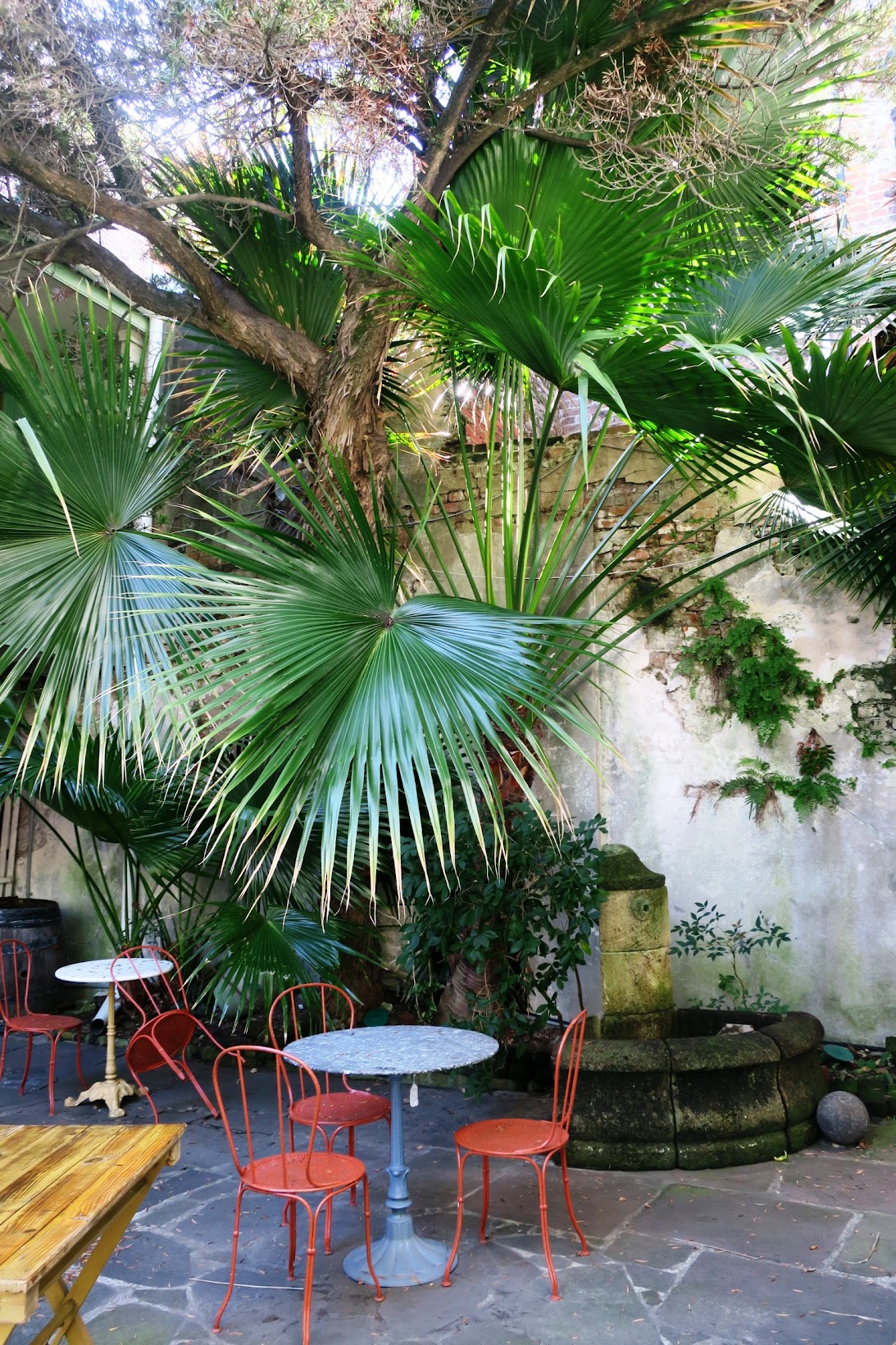
If all the beautiful objects become a little too overwhelming, one can easily step outside into the welcoming courtyard where - you guessed it - even more antiques await, casually displayed within their lush setting.

Chronica Domus
French café tables and chairs are set about the lush and tranquil courtyard
Photo: Chronica Domus


Chronica Domus
Heading back inside, I could not help but to look around in disbelief that
I was still in The United States of America and not in a village house in
southernEurope or the West Indies
Photo: Chronica Domus


Of course, a souvenir of my visit was most certainly in order and as Mr. Dunne was presently on a buying trip in France, his capable and gracious staff was on hand to assist.  

The playful Mr. Kerry Moody was all too happy to ham it up for the 
camera, with an appropriate prop, of course
Photo: Chronica Domus


Circling back to one of the silver cabinets piled with silver items, Ms. Michele was most helpful when it came time to make my purchase.  Wouldn't you just know it, in a shop stocked primarily with French antiques, it was an English piece that had caught my eye. 

Chronica Domus
A sterling silver ladle with crest by London silversmith Henry Sardet 
circa 1804 was going home with me
Photo: Chronica Domus


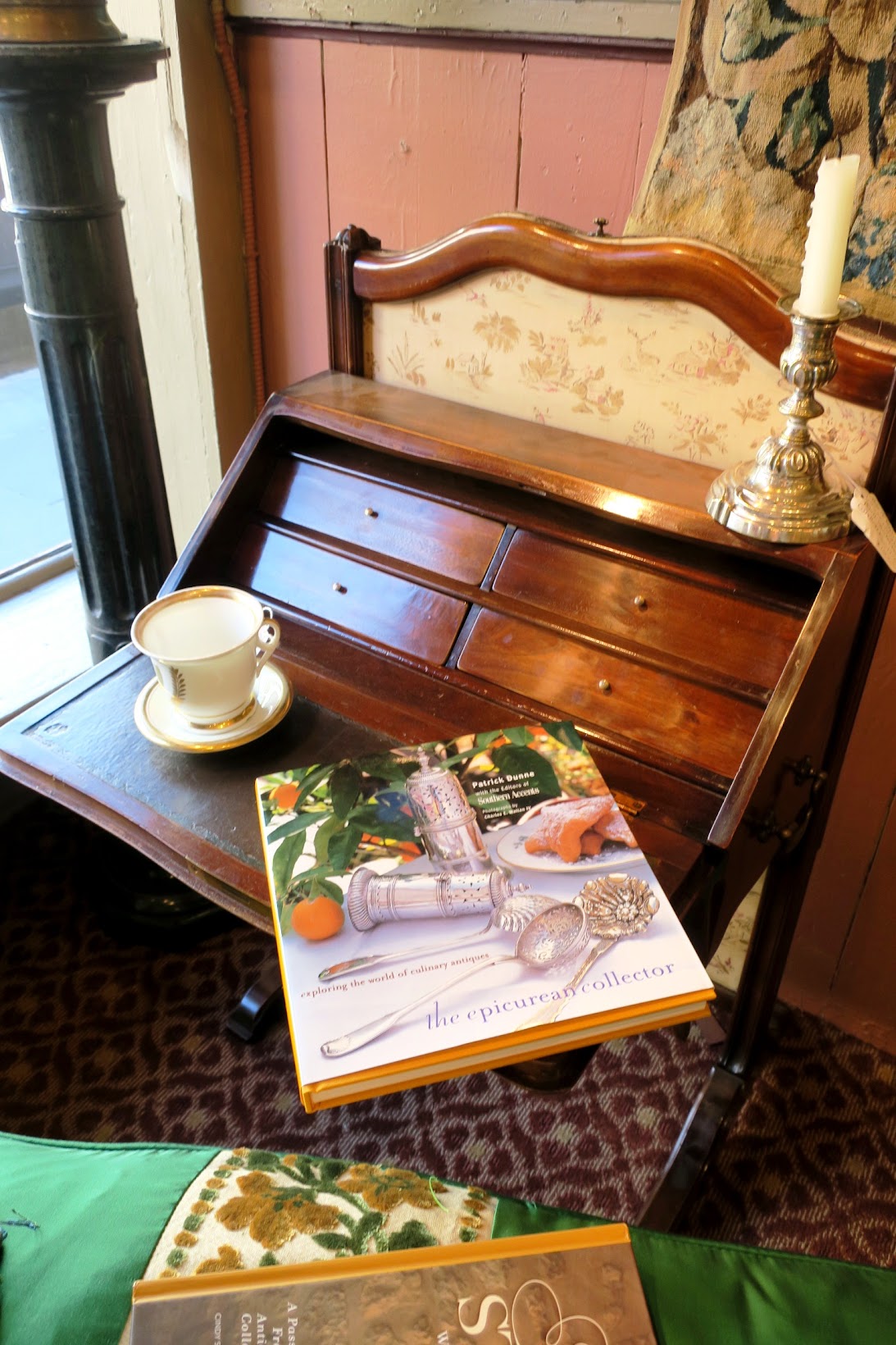
I was leaving Lucullus Antiques not only a delighted customer, but one that will recall her visit with fondness whenever her new old ladle is pressed into service.  And, just as Mr. Moody bid me adieu, I spied a copy of the very book that inspired my visit, The Epicurean Collector, perched upon a small writing desk waiting to be discovered.
Chronica Domus
Photo: Chronica Domus


Please do yourself a favor and pay a visit to Lucullus Antiques the next time you are in the French Quarter of New Orleans.  There's really no other place quite like it.  And, if you can't get there in person any time soon, crack open the cover of Patrick Dunne's marvelous and informative book, The Epicurean Collector, for a fascinating read on food history and culinary traditions. 

I do leave you with a few words of warning however: You may just be inspired to begin a new collection of something you had no idea ever existed before thumbing through the pages of this book.  Absinthe spoons, anyone?

Lucullus Antiques
610 Chartres Street
New Orleans, LA 70130
Tel: 1 (504) 528-9620


Nota bene: I am neither paid nor do I receive recompense in exchange for applauding products or services within my blog.  I do so because I enjoy them.  If you are a kindred spirit, you too enjoy recommending nice things to fellow good eggs.

Friday, November 2, 2018

A Son's Poignant Remembrance On All Souls' Day

Chronica Domus
A son mourns the loss of his father
Photo: Chronica Domus


Since the early days of this blog, I have published a post each year to coincide with All Souls' Day.  These posts showcase a different item from a small group of mourning hair art that my husband and I have collected over the years.  As I sit in front of the keyboard preparing to write these annual blog entries, a funny thing happens; my mind begins to drift.  I contemplate how it is that we have become the stewards of these very personal mementos of other people's relatives. Then, I find myself reminiscing about my own dearly departed friends, relations, and animal companions with fondness and with gratitude for having known them.  In an odd way, by writing about our collection, my cherished memories of the people and animals who helped create them remain aglow in my mind's eye.

Now, let's return to the subject at hand, this year's featured mourning item.  As you can see from the preceding photograph, this art piece is yet another outstanding example that demonstrates the meticulous skill of the artist when composing a picture made entirely out of human hair.  Every strand has been cut and laid out just so, or finely snipped and pounded into position on a thinly-sliced ivory disc.  The masterly shading brings a wonderful sense of depth to the scene.  I suspect the different color hair used is a blend from the mourner and the deceased.  The whole forms a poignant mourning scene.  And, as with last year's example, this one is quite a rarity too. The inclusion of a human figure carried a far higher price tag for the person commissioning the work than, for example, a more typical mourning scene depicting just a tomb.

French in origin and likely dating to around 1830 to 1840, this piece includes several of the most common symbols of mourning.  The weeping willow tree is there, the draped urn atop the tomb, and even a lone pansy to represent love and admiration of one person for another.

The mourner, a young dark-haired gentleman sporting a smart tailcoat, is kneeling by the tomb of his father.  We learn of his relationship to the deceased because the gentleman is shown in the act of painting an inscription on the tomb.  From what I am able to determine when squinting at studying the minuscule words, which are written in French, they read O mon pere! un jour viendra ...  I take this to mean that father and son will one day be reunited.

Chronica Domus
Housed within its original frame and stamped brass ring, this happens to be one of
my favorite pieces in our collection
Photo: Chronica Domus


This particular mourning hair work hangs on the wall of our home's vestibule.  It is grouped with two other examples of mourning hair art that I've written about here and here.  I love how they are reflected in the small Regency era convex mirror, seen in the below photograph.  

Chronica Domus
Three early-nineteenth century mourning hair artworks
grace the walls of our home's vestibule
Photo: Chronica Domus


Other pieces in our collection hang on the walls of our bedroom.  A few are even tucked away in drawers, waiting in the wings to be paired with future acquisitions.  As you can well imagine, aside from a healthy dose of patience, a collection as unusual as this takes many years to cobble together.  


This grouping of two mourning hair artworks is found in our bedroom
Photo: Chronica Domus


Chronica Domus
This is one of a pair of mourning hair artworks believed to memorialize the
lives of a husband and wife
Photo: Chronica Domus


Here are the four mourning hair artworks in situ
Photo: Chronica Domus


Tell me, is there something in your possession that holds sentimental value and reminds you fondly of a dearly departed friend or relative you may be thinking about today on All Souls' Day?

Sunday, October 14, 2018

A Successful Day At Auction & A Connection To An Important Welsh Ceramics Collection

Chronica Domus
Two auction attendees contemplate their bidding strategy
Photo: Chronica Domus


It has been an age since I was motivated enough to haul my caboose out of the house on a weekend morning to attend a live auction. One bright and sunny day last month, my husband and I did just that, taking our ringside seats at the hottest event in town.  Fellow ceramics collectors, clutch your paddles tight.  I am about to show you what it was that had me so revved up. 

While some attending the sale anticipated successful bids on the Picassos, Chagalls, or Dalis on offer, it was the numerous lots of English ceramics of the late-eighteenth to early-nineteenth century that lured me in like a fish to water.  Now, let me preface my scribblings by stating that in my part of the world, stumbling across a piece of early porcelain or creamware on my travels is a rare thing indeed.  These utilitarian (and fragile) articles were, after all, manufactured in potteries located on the other side of the world, on a small island over two centuries ago.  Bearing all that in mind, you can well imagine my delight at being confronted by the glorious vision captured in the photograph below:


Chronica Domus
A display case chock-full of early Wedgwood and Spode creamware table articles
spells danger for this particular addict collector
Photo: Chronica Domus


And, for admirers of early drabware ceramics, feast your eyes on this:

Chronica Domus
No, this is not a decorative arts museum's exhibit but the contents of a
single lot for sale at auction
Photo: Chronica Domus


Or, how about some neoclassically decorated English porcelain?  There was plenty of that to go around too.

Chronica Domus
Yes, please!
Photo: Chronica Domus


Chronica Domus
A Coalport tea service in a pretty orange and gilt pattern, circa 1820
Photo: Chronica Domus


After a brief confab with my husband, it was settled.  One of the creamware lots would - fingers crossed - be going home with us.  Spotting at least one other interested party circling the display cases and pacing between the creamware and the silver lots, we might be up against competition.

The lot that piqued our interest happened to be the final one of the early ceramics.  First under the auctioneer's gavel was the drabware, sold to an Internet bidder at, astonishingly, less than the bottom end of estimate.  Next, the first of two lots of Spode Greek pattern.  That too sold at a very reasonable hammer price. The creamware was next ...

Chronica Domus
Sold! ... Nine pieces of Wedgwood's Flute and Wreath pattern
Photo: Chronica Domus


Chronica Domus
Sold!... Wedgwood's Etruscan Pattern 42 in red and black and
Pattern 93 in yellow and black enamel, circa 1785 - 1790
Photo: Chronica Domus


Chronica Domus
Sold!... Five pieces (two out of range of this photograph) of Wedgwood's Pattern 94
Photo: Chronica Domus


Chronica Domus
Sold!... A large covered dish in brown and yellow enamel and an integral sauce tureen
Photo: Chronica Domus


Bidding was fast and furious and after several of the English porcelain lots came and went, it was time to take my paddle to hand and steel myself for the battle ahead. It helps, of course, to have the support of one's dear husband who is not such a bag of nerves when it comes to these matters. He usually wields the paddle but on this occasion, I found the strength to raise my own. As luck would have it, the experience was not at all intimidating. It did help that I was the only interested bidder. Sold! to the lady who almost fainted from the rush of excitement when the gavel finally dropped. We were going home with not one but two shelves full of delicious creamware plates and serving dishes (seen in the second top photograph of this post).

Chronica Domus
The winning lot!
Photo: Chronica Domus


Accompanying the stack of ten plates is a large shapely serving dish in the same hand-painted geometric pattern.  

Chronica Domus
It is hard to believe that this pristine Wedgwood serving dish is over 200 years old
Photo: Chronica Domus


Chronica Domus
A pair of Spode creamware supper dishes painted in a similar orange and black
enamel to the Wedgwood pieces are also included in the lot
Photo: Chronica Domus


The story of the winning ceramics doesn't quite end here.  A further serving dish included in the lot yielded a clue as to the previous owner.  It is always an exciting prospect to ponder where such humble household articles began their life, how they were used, and who cared for them along the way.  

Chronica Domus
Aha! A clue to where these dishes once lurked
Photo: Chronica Domus


Chronica Domus
Who might Grant-Davidson be I wonder?
Photo: Chronica Domus


A collector's label affixed to the underside of the dish prompted a little Internet sleuthing which soon revealed the identify of Grant-Davidson as the author of the following book:

Chronica Domus


Yes, that's right, my new old creamware dishes once formed part of the private collection of internationally recognized ceramics expert Mr. Wallace James Grant-Davidson.  

Mr. Wallace James Grant-Davidson proudly showing off part of his ceramics collection

Mr. Grant-Davidson, a historian and authority on Welsh pottery, was also an extraordinary lifetime collector of eighteenth and nineteenth century British porcelain and ceramics.  Following his death in 1999, Sotheby's was charged with dispensing the collection which included pieces of Whieldon, redware, stoneware, pratt-type wares, delftware, Staffordshire and Sunderland lustreware as well as creamware.  The collection was broken up into 270 lots that raised a sum of £110,975.

It is a rare privilege indeed to be privy to information on the provenance of newly acquired items at auction beyond, of course, what the seller provides the auction house.  This is why I was so pleased to discover the collection label attached to the underside of one of my plates.  The label led me to some fascinating information released by Sotheby's in the run up to the sale.  It identifies exactly where these dishes last resided during their two-hundred year history:

"The whole house was decorated with the china", Mrs. Margaret Grant-Davidson said; "every room had pieces on the walls, it covered the walls in the study, the bedroom, the dining room and even up the stairs!  My husband was a true collector, he brought what he liked.  I was married to him for more than 60 years and he was so meticulous and kept everything.  It is taking me a long time to sort things out and I am still finding things that I never knew we had.  I have kept many items as the house would be bare otherwise". 

It is pleasing to imagine that a humble Welsh house in Swansea was once home to such an extraordinary and well-loved collection of ceramics.  And now, here in my own humble abode, half way across the world, Mr. Grant-Davidson's dishes have somehow found their way to me.  I wonder where they'll end up next?  Until that day dawns, I look forward to using and enjoying my creamware, and setting it atop my period appropriate English mahogany dining table, alongside period glassware and silver.  Who knows, perhaps table and plate might have already met at a long-past luncheon or dinner party. 

Now, if you'll please excuse me, I'm off to hatch a plan for my creamware's coming out party ...

Thursday, April 26, 2018

A Bird-Themed Silver Lustre Creamware Jug To Mark National Audubon Day

Chronica Domus
Photo: Chronica Domus


Today, April 26, is National Audubon Day.  It is the day that Franco-American ornithologist John James Audubon (b. April 26, 1785 d. January 27, 1851) is commemorated.  Audubon is best known for his color-plate publication The Birds of America (1827 - 1838).  The multi-volume tome is still considered to be one of the finest ornithological works ever published and contains 435 hand-colored plates of North American birds placed within their natural habitats. The illustrations are a feast for the eyes.  

Chronica Domus
I'm sure many of you are familiar with Audubon's work, here is
"Blue Crane or Heron" from the book The Birds of America (1827 - 1838)


Early this morning, after replenishing the seed in the bird feeder which hangs from the pear tree in my garden, I thought I would mark the day by making a simple flower arrangement using an appropriately decorated vessel.  Of course, as you can guess, the vessel is bird-themed.

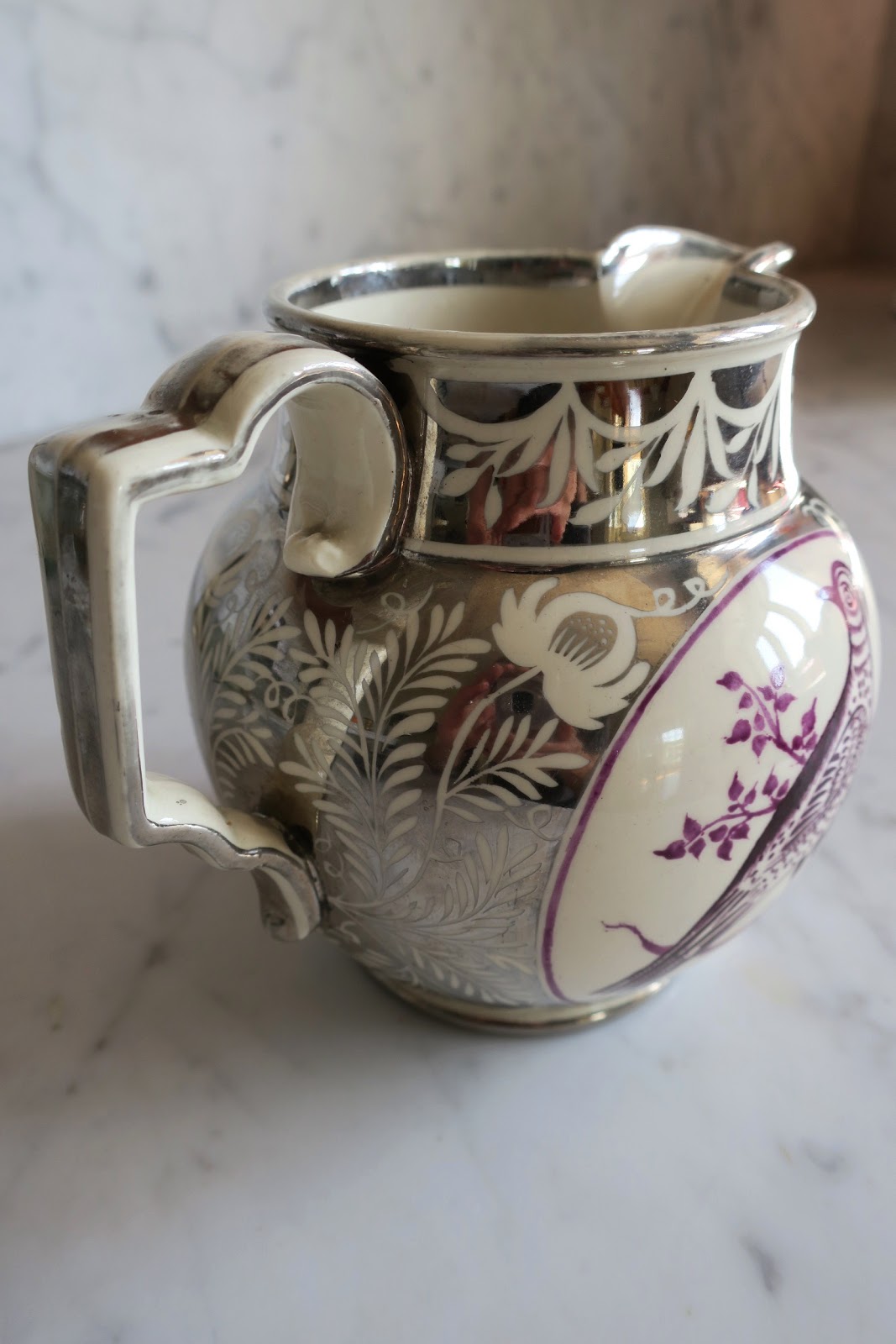
The creamware pitcher I used was made in England during the first quarter of the nineteenth century.  It is hand-painted using purple enamel (or would that be puce?), and silver lustre (or would that be silver resist?).  There is some debate in the ceramics world as to when exactly it was that the silver decoration, commonly referred to as silver lustre, was first utilized by the English potteries and ceramics factories.  In fact, it turns out that the metallic decoration is not derived from silver at all. While researching this post, I happily stumbled across an excellent and absorbing article published by Johnson Matthey Plc, found here.  It details how platinum came to be used to mimic the effect of silver on these early ceramic pieces.  And, although the label I found adhered to the base of my jug identifies it as having been manufactured between 1790 - 1800, the Johnson Matthey article states the first use of "silver" decoration began slightly later in 1805.  It was John Hancock of Hanley in Stoke-on-Trent who invented the lustrous decorative glaze while working at the Spode factory. 

Chronica Domus
The label on the underside of my jug reads "Leeds: Resist Lustre Period 1790 - 1800"
Photo: Chronica Domus


Chronica Domus
This type of decoration is known as silver lustre or more accurately as silver resist or steel resist lustre and is achieved by painting the design - in this case the foliage - with glue and a glycerin or honey mixture which is washed away after the jug has been dipped in the platinum lustre prior to firing
Photo: Chronica Domus


Chronica Domus
Another view of the silver resist and purple (or puce) enamel decoration
Photo: Chronica Domus


I purchased the jug from an antiques shop one day while visiting my husband's uncle and aunt.  The shop is but a short distance by car from their house.  I happened to spot the jug sitting in a locked glass case in the back of the shop.  The dealer who opened the case for me made it impossible to walk away empty handed.  "I've had this jug for ten years and I want it to go to a good home" he said.  "If you like it, I will sell it to you for half the sticker price".  What the dealer did not know was that I had every intention of buying his lavishly decorated jug as not only did I find the piece to be rather pretty, but it was also in excellent condition with not a crack, chip, or nibble to be found upon it.  Frankly, I was astonished it had languished behind glass for an entire decade.  The dealer's offer certainly sweetened the deal and I am thrilled to have added the pitcher to my ever-increasing ceramics collection.  Below is an almost identical one sold at auction six years ago.

Chronica Domus
Here's a mate to my jug, sold at auction in 2012 and described as a silver resist lustre 
Leeds "songbird on a fence" jug, circa 1810 - 1815


Before I get too carried away with the details of the vessel's decoration, here it is in situ, in our drawing room.  It holds lusciously dense panicles of lilac, the color of which is almost indistinguishable to the painted song bird decoration.  

Chronica Domus
An arrangement of lilacs in celebration of National Audubon Day
Photo: Chronica Domus


Today, I encourage you all to venture outdoors and enjoy a little bird song, and to also appreciate the local variety of birds flying freely through the (hopefully) blue skies of your neighborhood.

John James Audubon 1785 - 1851
by John Syme

Within a few minutes of stepping into my own garden this morning, I have already heard the squawking of a Scrub Jay, the gentle cooing of a Mourning Dove, and the buoyant chirping of a multitude of Sparrows.  What a joy and a privilege it is to experience such an agreeable nature-borne melody.  Do please tell me what birds you might happen to hear singing in your garden today.


Saturday, March 31, 2018

Norton Helps Prepare Some Easter Flowers

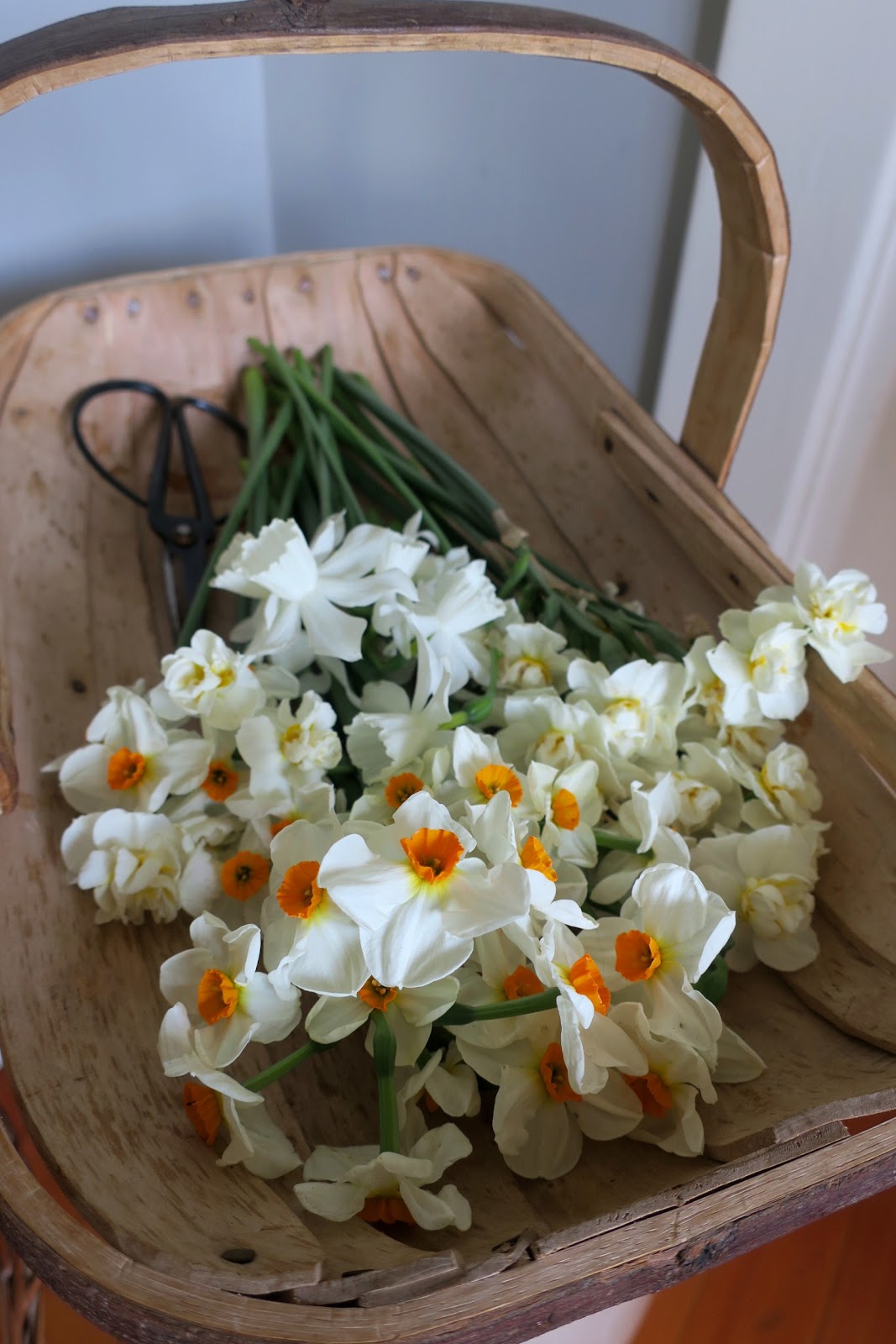
Although we won't be home for Easter Sunday this year, I am still compelled to add a few festive touches to the house to mark the holiday.  So, bright and early this morning, Norton and I trotted down to the garden to snip away at some of the narcissi I had planted in mid-February. Anticipating, with a bit of luck, that most of them would have bloomed for Easter, it turns out, most of them had.

Chronica Domus
Planted on February 19, narcissus Cragford, an award-winning heirloom, 
is ready for picking
Photo: Chronica Domus


Chronica Domus
Another heirloom variety that bloomed vigorously this year is the aptly named 
narcissus Cheerfulness 
Photo: Chronica Domus


It did not take long to fill my trug but I must admit, I did receive a little help from Norton.

Chronica Domus
Norton supervising in the cutting garden
Photo: Chronica Domus


As you can see below, the effort of picking a few narcissi was all a tad too much for dear Norton. Declaring he'd had quite enough of it all, he proceeded to plonk himself smack dab in the middle of the vegetable patch, exhausted it seems.

Chronica Domus
Gardening is so overrated!
Photo: Chronica Domus


Coming into the house via the back stairwell, Norton was obviously still very tired from his gardening escapades so I left him there, with the trug, while I nipped downstairs and around to the front garden to clip a few more blooms.

Chronica Domus
Norton takes a well-earned break
Photo: Chronica Domus


Chronica Domus
Narcissus Thalia, my favorite of the whites, has been reliably blooming and multiplying in 
my front garden for several years
Photo: Chronica Domus


Chronica Domus
Just a few Thalia to complete the morning's pickings
Photo: Chronica Domus

I had adequate blooms to make two cheery arrangements to place in the drawing room, with a handful left over for a third smaller arrangement that I placed in the kitchen.

Chronica Domus
Photo: Chronica Domus


Chronica Domus
Here they are in situ
Photo: Chronica Domus


And, what would Easter be without a few chocolate treats to nibble upon?  Here are some chocolate eggs corralled in a favorite English Regency era teapot stand painted in a pleasing shade of orange to match the centers of narcissus Cragford.

Chronica Domus
Please, help yourself to a chocolate egg or two
Photo: Chronica Domus


My collection of various bird eggs round out the decorations in the drawing room.  Eggs are, after all, symbols of rebirth and renewal at Easter time.  A glass vessel below holds quail, araucana chicken, and partridge eggs ...

Chronica Domus

Photo: Chronica Domus

... and another holds a turkey egg, the egg of a scrub jay, and more delicately-shaded araucana chicken eggs.

Chronica Domus
Photo: Chronica Domus


Chronica Domus
A simple but pleasing Easter arrangement in the drawing room
Photo: Chronica Domus


Oh, and I almost forgot the funnest, and smallest, decoration in the house, a charming vintage hen and her chicks.  They grace a porcelain stand on the kitchen counter.  Don't you think Mrs. Hen and her brood look quite at home surrounded by ... more eggs!
Chronica Domus
Happy Easter Everyone!
Photo: Chronica Domus

Norton and I wish you all a very Happy Easter!


Related Posts Plugin for WordPress, Blogger...