A home grown Jeffersonian salad comprised of Spotted Aleppo lettuce, nasturtium flowers and French tarragon
Photo: Chronica Domus
As readers of this blog will learn over time, I am partial to the decorative arts of England, America, and France during the late 18th and early 19th centuries. Not only do I enjoy collecting and using items from this period for my home, whenever the opportunity arises and when funds permit, I also enjoy sourcing heirloom plants, both ornamental and useful, to add to my garden. To that effect, it was with great pleasure that I had the opportunity to visit one of America's premier antique vegetable gardens, perched high upon the side of a mountain in Charlottesville, Virginia, and created by Thomas Jefferson at his home,
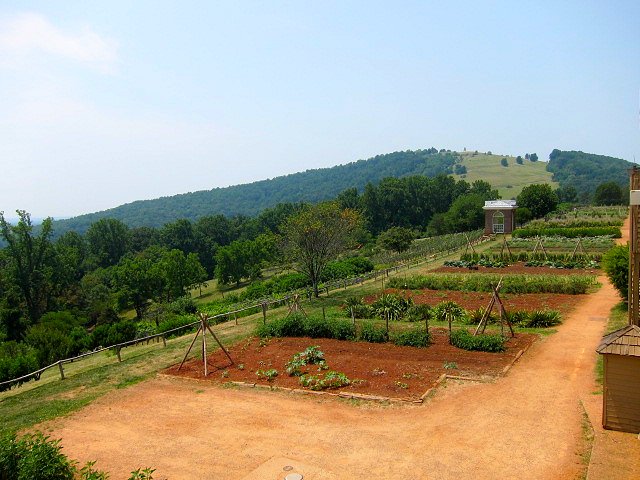
Monticello. Jefferson, America's third president and the principal author of the Declaration of Independence, was an accomplished tobacco and grain farmer and a grower of fruits and vegetables. Through constant experimentation, and at the garden's most productive period around 1812, the one-thousand foot-long terraced plot was used to grow at least 330 varieties of vegetables, most of which were used to feed family and visitors at Monticello.
High summer in the vegetable gardens of Monticello, photographed during my visit in 2012
Photo: Chronica Domus
On May 6, 1795 the sage of Monticello wrote in his journal "The first lettuce comes to the table". Well, I am pleased as punch to report that exactly 219 years later, give a day or two, my first Jeffersonian lettuce has arrived at my own table. You see, when I visited the garden two summers ago, I came away with a souvenir; two packets of heirloom seeds harvested by those that tend Monticello's garden today. I selected the seeds based on the fact that the varieties were grown on site in Jefferson's lifetime, not easily found elsewhere for purchase, and that frankly, I was unaware of the existence of the curious sounding Spotted Aleppo lettuce. I was very keen to take a little bit of Monticello back with me to California, a place virtually unknown to Jefferson, in an attempt to cultivate the very same lettuce he grew all those years ago in Virginia. Perhaps, if successful, I could even go as far as recreating a salad that would have been made in the kitchens of his home, and served to Jefferson, his family, and his guests. Would such a salad taste and look differently than if I used modern varieties of lettuces available today? I was curious and excited to make the discovery for myself.

An attractive seed packet of Lactuca sativa 'Spotted Aleppo' lettuce seeds harvested from plants grown at Monticello
Photo: Chronica Domus
This is the second season since purchasing my seeds that I have planted Spotted Aleppo, an 18th century variety regularly grown at Monticello and first procured in 1804 from Bernard McMahon, a prominent Philadelphia seedsman and mentor to Thomas Jefferson. I was so enamored by the initial crop last year, and found it easy to cultivate, that I let the plants go to seed so as to enable me to collect more than enough for this year's sowing. It was recorded that lettuce was planted an average of eight times annually at Monticello during the years 1809 through 1824. Obviously, salads played a prominent role in Jefferson's diet.
A head of Spotted Aleppo lettuce exhibiting the characteristic rusty brown spots
Photo: Chronica Domus
I sowed my seeds on St. Patrick's day, March 17, in neat little rows in my Lilliputian vegetable garden. It took about a week until the cotyledons, the first sign of germination, pushed through the cool black earth. Those tiny leaves are always such an exciting time for any gardener to spot, full of hope and optimism for a bountiful crop. On May 9, with less than six weeks in the ground, I harvested enough tender leaves to make my salad, picked in the early morning sunshine, just as they were at Monticello, then laid in cool water and removed hours before they were needed at dinner. At maturity I discovered the Spotted Aleppo, a type of romaine lettuce, is far more diminutive in scale than the hefty romaine we know today. I estimate that the length of the leaves are no more than about eight inches. They are also much more tender and delicate, and not at all tough and crunchy.
More of Jefferson's speckled lettuces basking in the sunshine of my vegetable garden
Photo: Chronica Domus
Esculent nasturtium flowers, that grow with abandon in my garden, were added to the lettuce leaves so that I could accurately recreate a salad that would have been a familiar sight at the dining tables of Monticello. Not only were these cheery flowers used to prepare salads by Jefferson's cooks, the leaves too were mixed in with other greens and lettuces. Nasturtium seeds were also utilized surprisingly, so nothing went to waste. These were a substitute for capers so I would imagine they were somehow pickled to serve their purpose. An 1,800 square foot bed was dedicated to the growth of nasturtiums at Monticello, planted annually between 1812 and 1824.
My garden trug holding freshly picked lettuce leaves and nasturtium flowers ready to be taken into the house
Photo: Chronica Domus
Jefferson's travels to Europe helped hone his interest in French cuisine and opened new gastronomical worlds for him. He would send back foodstuffs, such as wine vinegar and virgin olive oil from France, to be used in the preparation of salads and vegetables. As much as he enjoyed expensive imported olive oil, he did note that the freshness was somewhat compromised through its exposure to hot storage environments as it made its passage across the Atlantic ocean and to his home. With this in mind, he experimented with growing sesame plants to produce a domestic salad oil that would provide a possible substitute for his favored olive oil, having once described it as "the richest gift of heaven". Of sesame oil he said, "I did not believe there existed so perfect a substitute for olive oil". Try as he might, he could not produce a worthwhile quantity of oil from his sesame plants despite seven years of persistence.
Salads at Monticello would be dressed at table with the oil and vinegar having been stored in glass cruets. In my recreation of the salad, I substituted Spanish wine vinegar for tarragon vinegar, which was often used at Monticello, and introduced freshly cut French tarragon, Thomas Jefferson's favorite herb, into the mix of lettuces and nasturtium flowers. With the final addition of a sprinkling of coarse salt, and a crack or two of the pepper mill, my home grown Jeffersonian salad was complete.
Late 18th century glass cruet bottles containing extra virgin olive oil and wine vinegar to dress the salad. Jefferson used similar bottles but his were designed with a silver lip and handle.
Photo: Chronica Domus
An antique salad recognizable to Thomas Jefferson had he been a guest at my table
Photo: Chronica Domus
Dinner was served much earlier in Jefferson's day and to honor that tradition my salad was eaten around 4 p.m., the time the second bell rang to alert guests that they should assemble in the dining room to begin their meal at Monticello.
All done, and how delicious that was!
Photo: Chronica Domus
As I sampled the tender spotted leaves, the peppery bright flowers, and the pungent French tarragon, I toasted Jefferson and thanked him for his inspiration that I might eat as well as he, on simple food that had been grown in my own garden, with seeds from his. It was, indeed, a most satisfactory feeling. To these simple ingredients, the addition of imported olive oil and vinegar that is now shipped to my home in a matter of days rather than weeks, as was the case in Jefferson's day, completed my salad, an edible antique and one that would be wholly recognizable to him were he to have joined me at my humble table. I can only imagine the conversation that would ensue. Would we wax lyrical about the quality, variety, and sheer quantity of food available to us in 21st century America? Would he be surprised and pleased to discover how much of that food was locally grown and produced in California, including his favorite salad oil? And, what would he think of food globally produced, much of it perishable, and flown magically through the skies to reach our plates in peak condition? Would we also deliberate, in shared disappointment, the modern norm of so few meals being taken while actually seated at a dining table?
Growing your own antique salad can successfully be accomplished in a small corner of the garden or through the use of several large containers. Fortunately, one need no longer make the pilgrimage to Monticello to lay hands on these heirloom jewels, thanks to the modern wonders of
internet shopping. I urge you to try these surprisingly tasty old varieties for you too will discover their ease of growth and their deliciousness.
Our eating habits may have changed over the past two
centuries but one thing that will always remain the same is our tendency
towards Jefferson's famed "pursuit of happiness". For those much like
myself, this will always include good friends, lively conversation, a
shared bottle of wine, and wonderfully simple meals boasting of the
earth's bounty.
Nota bene: I am neither paid nor do I receive recompense in exchange for applauding products or services within my blog. I do so because I enjoy them. If you are a kindred spirit, you too enjoy recommending nice things to fellow good eggs.