Showing posts with label renovation and restoration. Show all posts

Monday, August 1, 2016

A Regency-Style Garden Bench for The Frankentrees

Chronica Domus
Our new old garden bench is in dire need of attention
Photo: Chronica Domus


High summer has arrived and the garden has become an absorbing outdoor playground as of late.  I am currently in the midst of a project that is focused around our Frankentrees, the very trees that were the subject of a post I published two years ago.

I have been patiently training these apple trees into an arch, dreaming that one day I might set a pretty garden seat beneath it.  It would, I imagined, be a place for this gentlewoman gardener to rest her weary body between the endless cycles of deadheading and weeding. 

Recently I happened across the garden bench of my dreams, an English Regency-style iron example. I believe it was made at the beginning of the twentieth century and was originally painted bronze green but has since been painted white.  Its sturdy construction is far superior in quality to anything available for sale today at mass-market garden centers and big-box chains. Besides, this is not a style which one typically sees for sale at such outlets or elsewhere, come to think of it. I am, to say the least, tickled pink to have found it.

Chronica Domus
A Regency iron garden bench, circa 1810, with characteristic serpentine back and curved arms - the diamond-shaped embellishments make this bench much fancier than was typical of the era


Chronica Domus
Our Regency-style garden bench shares the same serpentine back and curved arms as the Regency example shown in the preceding photograph.  Notice, too, the similarities in the curlicues which decorate the top corners of both benches
Photo: Chronica Domus


The bench was perfect in every respect but one.  The painted surface was in such a state of degradation that it would literally fall away while being handled.  I spent the better part of two uncomfortably hot days with my face encased in a dust mask laboring and scraping - in between muttering words not fit for print - until, finally, the ghastly stuff had been eviscerated.

I had every intention of repainting the bench until discussing the matter with my husband who came up with an excellent suggestion.  The result, he promised, would provide a durable, long-lasting finish that would greatly delay the need for future maintenance.  Best of all, it would immediately relieve me of several more days of hard graft.  Now, how could I possibly argue with that logic? Thank you, dear!

Loading up the Volvo with our shabby-looking bench, we set off in search of West Coast Powder Coating, a small local workshop which performs minor miracles on all manner of metal objects, including this one:

Chronica Domus
A familiar item from the shores of the United Kingdom, a red K2 model telephone box
in the midst of receiving a facelift
Photo: Chronica Domus


We left our garden bench in the very capable hands of Chris and his team, having selected just the right shade of white and degree of gloss in the finish (70%).  By the way, Chris told me I need not have bothered scraping away the paint as the bench would be sandblasted prior to receiving its coat of primer and powder coating.

A week later, we returned to find this:

Chronica Domus
Chris rightly beams with pride and joy as he shows off the workmanship involved in resurrecting
our Regency-style garden seat
Photo: Chronica Domus  


We could not be more pleased with the skillful work Chris and his team performed, insuring our old garden bench will be enjoyed for many years to come.  The industrial-strength finish, he tells us, should last for many years.

The hard toil is certainly not over yet (is it ever "over" when it comes to the garden?).  Plans are afoot to complete the area around the Frankentrees and directly beneath the bench.  For now, I can at least rest my wicker basket upon our garden's newly restored installation while I gather the remainder of the apple harvest, which arrived rather early this year.    

Chronica Domus
Rosy-hued apples await picking
Photo: Chronica Domus

Chronica Domus
Finally! The perfect Regency-style garden bench to place beneath the apple arch
Photo: Chronica Domus


I do hope you enjoyed reading about the revival of this particular garden bench and that it might inspire you too to breath new life into a tired piece of outdoor furniture.


West Coast Powder Coating
165 Mitchell Ave, South San Francisco, CA
Tel: (650) 871-0400

Nota bene: I am neither paid nor do I receive recompense in exchange for applauding products or services within my blog.  I do so because I enjoy them.  If you are a kindred spirit, you too enjoy recommending nice things to fellow good eggs.

Wednesday, October 7, 2015

Relics Reimagined: A Morandiesque Hanging Shelf

Chronica Domus
A rescued early-twentieth century spice rack has found new life as a hanging wall shelf corralling diminutive earthenware vessels à la Giorgio Morandi
(Please excuse my crooked photography. The hanging shelf is, in fact, mounted perfectly plumb)
Photo: Chronica Domus


There is a new addition to the stairwell, an area we consider a transitional space between the living quarters upstairs and the basement level leading to the garden.  I'm thrilled to bits with it.

I've been on the hunt these past few years for a simple hanging wall shelf and I finally located one just the other day while walking Mavro around the neighborhood early on a bright and sunny morn. It was lurking on the basement floor of a house up the hill from ours, and was sold to me for a mere three dollars at the family's tag sale. I wish I had taken a snap shot of it in its dusty and dirty state.  It was, quite frankly, a hideous mess. I'm sure the man who sold it to me thought me quite mad, of course. "Who in their right mind would want that?" I imagined was going through his mind as we exchanged shelf for dough. The wooden backing board had long ago been subjected to two crude holes, haphazardly off-set and not at all neatly centered as one might expect. Obviously, those required some attention.  A bit of patching and sanding was in order.  The remnant of thinly applied cream colored paint was still in evidence.  I believe the shelf once hung in the original 1920's era kitchen of the house in which I found it, and may have been used to hold tins of spices and seasonings. Despite the wall shelf's degraded appearance, it was still very sturdy and obviously well-made in its day by a carpenter, probably by the same hands that built the other cabinetry in the kitchen.  Ah, how one longs for the days before the dreaded flat-pack arrived on scene, killing the local carpenter.

With a gentle sanding and a lick or two of paint, I am now the proud owner of a practical and charming little hanging shelf that would very probably have met its death at the local dump had I not stepped in to rescue it. I think it looks perfectly lovely mounted on the wall of our stairwell, placed above the cache of traditional cleaning tools. Finally, a place for all my little earthenware vessels and flower scissors, making them easily accessible as I make my way back upstairs from the garden in readiness for arranging the little blooms I would have just gathered.  Oh, and I mustn't forget to mention the sweet little mochaware piggy bank, long-ago smashed to pieces and lovingly re-glued having been enjoyed by an excited child surely saving for a treasure. It looks quite content sharing real estate alongside the other diminutive items on the shelf.

Chronica Domus
Photo: Chronica Domus


After spending a bit of time fussing with the placement of all the objects, I stepped back to admire my handiwork.  I noticed the hanging shelf had taken on a Giorgio Morandiesque air in its composition. Would you not agree?

Chronica Domus
A still life by Giorgio Morandi


Chronica Domus
Life imitates art
Photo: Chronica Domus


Chronica Domus
Yet another still life by the artist
Source

Chronica Domus
A corner of Mr. Morandi's studio showing his collection of vessels which inspired the artist's oeuvre


The next time you find an object that is destined for the landfill, do consider for a moment whether it may be something you could reimagine with a little elbow grease. You will not only be rewarded with a useful or decorative item for pennies on the dollar, but you will have also played your part as a green citizen of our planet.

Tell me, do you enjoy the benefits of open shelving in your house, or do you prefer to stash your items in cupboards behind closed doors?

Sunday, September 14, 2014

Beyond The Plain White Door

Our desire to restore period-appropriate detail to our house is something we've pursued since taking ownership many years ago.  Not all of the projects we undertake are on a grand scale, but with every little detail we add (an old door knob, for example), we aim to turn back the clock, or at least give the impression that we have. Of course, balancing life in the modern world with old-world design can sometimes be tricky. We have learned not to be slavishly OCD about such matters, but merely to make selections which are as period sympathetic as we are able. We typically take our time when undertaking such things, primarily to insure they are done correctly, and that we have sufficient funds to cover the cost of the project at hand. Ridding our home of the incongruous and ill-fitting 1950's garage door has been on our renovation list for many years.  So, this past summer, with much excitement and hand-clapping, we finally set forth on realizing our long anticipated vision.

Chronica Domus
This door, which sits to the left of our garage, was the inspiration for the new garage door's design
Photo: Chronica Domus


From the very beginning, we settled on the theory that the original carriage doors would have been of similar design to that of the door photographed above. It is located adjacent to the garage and is original to the house. We believe this entrance was used by tradesmen and domestics, as it has its own separate doorbell, and is located at the back of the house. It is also the closest door leading to the kitchen. We took inspiration from this door when approaching our project, making modest but necessary adjustments to the scale of the fenestration.

It was important to us that as we were going to all the effort and expense of having the garage door custom made, it should look as authentic as possible and reminiscent of the original. As I wrote in my previous post here, we soon discovered that true carriage doors, which swing outward, would not work in our situation as our very modern motor car would fail to clear the opening.  With this in mind, we devised an alternative design that would, by all appearances, resemble the way in which we imagined the original doors to have looked. In essence, we would be building one solid "mock" carriage door, opening upward, thereby maintaining the adequate space required to park our vehicle. Sectional roll-up mock carriage doors were never considered as we did not feel the look of the tell-tale horizontal sections succeeded in allowing for the trick of the eye which was our aim. Additionally, it would be impossible to preserve the scale of the glazing pattern.  Our approach was one which our door maker Ron had never before undertaken, so this would be an interesting project for all involved.

If our project was to be a success, it was imperative that the design of the door appear as authentic as possible. Of particular concern was the glazing. Isn't all clear glass the same, one might ask? Well, the answer, of course, is certainly not.  One of the joys of the tradesmen's entrance door is peeking through the subtle distorted views produced by the old glass window panes.  This original glass possesses slight striations, pitting, and the occasional air bubble. The distortion is present because the glass utilized for glazing windows during the 19th and early 20th centuries was still being mouth-blown, producing this rather distinctive characteristic which is lacking in modern machine plate glass.

For a brief moment, we considered sourcing genuine old glass, often found at salvage yards.  The glazing would first have to be painstakingly removed from rickety old sash windows, always a nerve wracking and dicey proposition, before it is cut to size.  We have resorted to this laborious technique for earlier projects completed shortly after purchasing our house. The end result, however, carried a high price in terms of plenty of tears and vexation as, inevitably, much breakage would occur.  Often this would happen just as the final cut was being performed.  For later restoration projects, we turned to America's only vendor of authentic mouth-blown glass, S.A. Bendheim, who carry an excellent "light restoration" glass that is mouth-blown in a German factory employing the traditional blow-pipe method.  We were thrilled to discover an optional laminate feature available for projects such as ours, that require safety glass to be utilized for larger panes. We do, after all, live in a modern world where building codes cannot be bypassed for aesthetics, at least that is the case in our area of the world. The laminate, I am relieved to report, is imperceptible to the naked eye, and does not affect the final appearance of the glass. Our order was placed following, not prior, to the door's construction.  This is because final measurements for each window pane are double-checked to within an eighth of an inch, insuring the custom cut panes, once they arrive, would fit snugly between their muntins (or "sticks" as Ron likes to call them).

Once the issue of the glazing material was put to bed, we then turned our attentions to the hardware that would embellish our door. The carriage door handles would serve a decorative purpose only, having eliminated the need to open any doors outward.  We did, however, want to select a model to closely match those used on carriage doors of the era.  We took our cues from studying old catalogue illustrations, and from the design of the original black iron railing, located by our front door steps. We opted for a fine set of heavy-duty black forged iron handles, and bypassed the machine stamped pretenders which are so much easier to source.

The door handles on this carriage door date from the early 1920's and were made by the National Manufacturing Company
Photo: archive.org


A letter box or, as it is known in America, a mail slot, made of rich oiled bronze, was chosen in a size commensurate with early 20th century examples. As with practically everything else available for sale these days, the average size of a humble letter box has swelled during the decades since our house was built.  There are now two standard slot sizes from which to select.  A larger "magazine size" is best suited to the modern proportions of McMansionesque houses and, more appropriately for our modestly-sized garage, a smaller "letter size" slot.

Only after having sourced all of the bits and bobs that would help us achieve a period-appropriate look, were we ready to give Ron the green light to proceed with the construction of the door.  By doing our legwork upfront, we had eliminated any possible obstacle to insuring the completed door would look just as we wished. As the old cliché would have it, the devil is in the details.

Chronica Domus
Our garage door was built in the workroom of Artistic Garage Doors by a team of capable carpenters
Photo: Chronica Domus

Ron and his carpenters worked diligently to construct our door from high quality kiln dried wood using traditional joinery methods. We were thrilled to see the door's progress upon visiting the workroom just prior to installation. The door had received a snowy white undercoat of primer in preparation for glazing.

Chronica Domus
The first view of our mock carriage doors complete with an undercoat of white primer
Photo: Chronica Domus


Within a few days of the glass order arriving, and after examining each piece for breakage (there was none, we are pleased and relieved to report), the pieces were set between the muntins, and an appointment for delivery was made post haste.

I believe my husband may have been surprised at how much I squealed with delight upon seeing this:

Chronica Domus
Ron at work insuring the new door is installed correctly
Photo: Chronica Domus


It took Ron, with the aid of one of his carpenters, less than two hours to rid us of the ugly white 1950's garage door, and turn back the clock to the 1920's with our interpretation of what must surely resemble the original set of carriage doors. In the removal process, Ron had unearthed a little treasure. It was a rusty portion of the original top bolt mechanism that long ago held one of the two carriage doors in place. The piece had been buried beneath the supports of the 1950's installation for over half a century.

Chronica Domus
Long buried hardware which once secured the slide bolt of the original carriage doors
Photo: Chronica Domus


Below you see the completed new "mock" carriage door. We have painted it in the same plumy blue as the other exterior doors of our house, using a traditional paint brush. Yes, it may seem superfluous to mention this little detail, but it is surprising to learn how much painting is now accomplished with the aid of a spray gun, rendering the finish flat and characterless. No, we rather enjoy seeing brushstrokes on our wooden painted surfaces. The carriage door handles and letter box complete the smart tailored appearance of the door, and the light restoration glass gently distorts the gleaming reflection.

Chronica Domus
Don't you think the new door looks quite smart and a more appropriate choice for a 1920's era house?  Notice how the new door now seats flush in the opening, unlike the ill-installed 1950's door.
Photo: Chronica Domus


The magic of it all is that we are able to raise the door upwards mechanically.  Not only do we benefit from the modern convenience and practicalities of electricity, but we are also able to drive our much wider modern motor car comfortably through the opening.

Chronica Domus
The carriage door may appear old, but it has all the practicality of a modern-era door
Photo: Chronica Domus


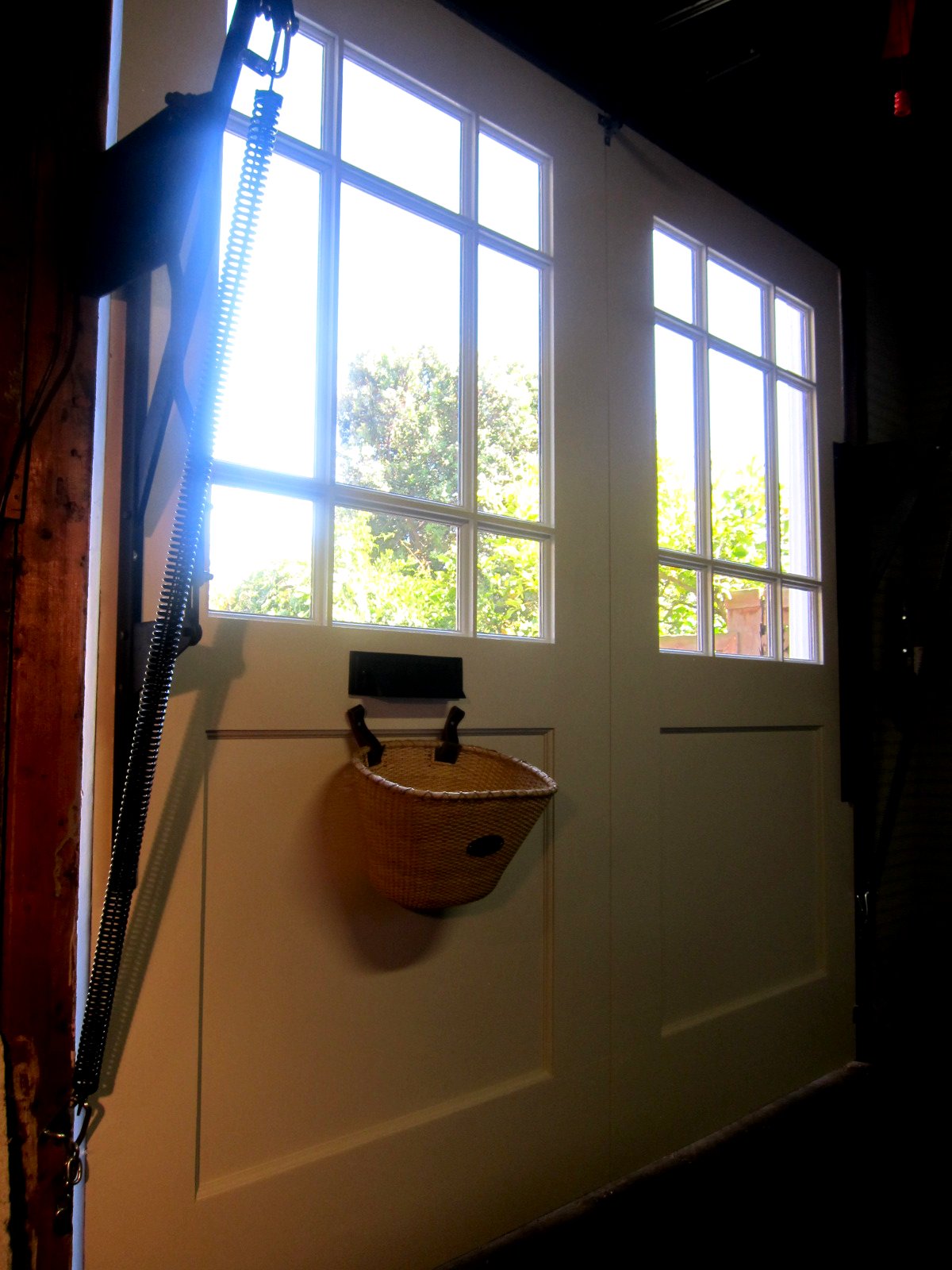
The photograph below shows the spring mechanism that makes it all possible. We find the door to be as beautiful from the inside as from the outside, thanks to Ron's capable carpentry skills.  An added benefit of replacing our windowless slab of a door is that the garage is now flooded with abundant natural light, making it a far more airy and pleasant environment. During the late afternoon, long rippling shadows are cast across the garage, a pleasant effect of the mouth-blown glass.  It is all quite lovely!  The fenestration also affords us a welcomed view of the greenery outside, a benefit we had not previously considered when planning the design of the door.

Chronica Domus
An inside view of the mock carriage door showing the springs that make it all possible
Photo: Chronica Domus


One final consideration was the question of how we would corral our daily mail as it is pushed through the letter box by our postman. We opted for a whimsical touch and thus hung a Nantucket wicker bicycle basket under the chute. The back of the roomy basket sits flush against the door, and can accommodate over a week's worth of mail if needed. The basket can also be removed with little effort if we are to be away from home for extended periods of time. This is accomplished by unbuckling the leather and brass fasteners, and replacing the bicycle basket with a much larger wicker basket positioned on the floor beneath the chute.


Chronica Domus
We added a whimsical yet practical solution for the collection of our daily mail; a Nantucket wicker bicycle basket
Photo: Chronica Domus


Chronica Domus
A view of the new garage door with our motor car tucked safely within
Photo: Chronica Domus


I hope you've enjoyed following along in our progress, and ultimate arrival to our very modern interpretation of traditional carriage doors. Wouldn't you agree that it constitutes a vast improvement over the prior incongruous flat panel?

Ron and his entire team were an absolute delight to work with. Together we met every challenge and obstacle to realizing our dream of restoring a touch more period-appropriate detail and dignity to the exterior of our home.

Now, onto the next project.

 Nota bene: I am neither paid nor do I receive recompense in exchange for applauding products or services within my blog.  I do so because I enjoy them.  If you are a kindred spirit, you too enjoy recommending nice things to fellow good eggs.

Saturday, September 6, 2014

"When one door closes ...

... another opens; but we often look so long and so regretfully upon the closed door, that we do not see the one which has opened for us".

Chronica Domus
The ill-fitting 1950's garage door that has been a constant source of vexation for me since moving into our home, seen here with a swatch of color and the mail slot removed
Photo: Chronica Domus


I respectfully disagree with Alexander Graham Bell, who famously uttered these words, at least when it comes to the subject of our garage door that is. I have known since the day we purchased our home, which was a very long time ago, that I would never regret the final closing of this particular door.

The original door to our garage, which was built in 1925, would have been of a very different design to that which is shown above, incongruously installed during the 1950's.

At the beginning of the 20th century architects began designing structures, similar to carriage houses, with the specific purpose of sheltering automobiles from the elements. The doors on these buildings were doubled, hung on hinges, and opened outward. They were known as carriage doors.  This was the type of door that originally dressed our garage, and a finishing touch which we longed to call upon in effort of restoring period-appropriate dignity to our home.

Chronica Domus
An example of early 20th century carriage doors similar to those which would have been original to our home
Photo: archive.org

Ah, you might think, an easy task once one has clarity of vision as to what is desired. As it turned out, it was a more complicated project than we had anticipated and many obstacles were to present along the way.  Firstly, where does one go to find such a set of doors?  The answer was certainly not the standard building supply outlets offering modern roll-up sectional garage doors.  The few salvage yards in our area were trolled over the period of several months, but the examples we saw were beyond what we would consider salvageable.  Besides, what were the chances of finding an exact fit? We soon came to the realization that there was only one option available to us, and that was to have the doors custom made.  Which brings us to our second obstacle.  Who could we possibly turn to to get the job done right?  

Again, this was not an easy task.  We followed many leads but unlike finding painters and general contractors, which are a dime a dozen, finding a capable person to build a set of carriage doors in our area was like finding a grain of wheat among the chaff.

Serendipitous circumstance led us to our answer.  We had worked with a painter last summer that mentioned a recent job he had completed where the owners had designed a garage door to be made to their specifications.  I excitedly asked the painter for contact details of the door maker, in hopes of following up with him.  Soon thereafter, we had scheduled an appointment with Ron, the owner of  Artistic Garage Doors, so that he could visit our home and discuss our project.  

Ron soon let us know that he could build anything we might desire but true carriage doors would not work for our situation.  Our Volvo wagon demands more shoulder room than the Tin Lizzy which might well have rested within the garage when first built.  Our existing door opens upwards.  True carriage doors which swing outwards would cause us to forfeit several inches of space from each side of the opening due to hinge requirements. This would present us with the problem of not actually being able to park our car in the garage as it would no longer clear the opening, making it somewhat less useful.

It seemed our desire to install period-appropriate carriage doors was to be foiled, or was it?

In my next posting I will share our altered approach to overcoming obstacles and finally realizing our vision.

 Nota bene: I am neither paid nor do I receive recompense in exchange for applauding products or services within my blog.  I do so because I enjoy them.  If you are a kindred spirit, you too enjoy recommending nice things to fellow good eggs.
Related Posts Plugin for WordPress, Blogger...