Readying the table for dinner with the first crop of heirloom Prince Albert peas
Photo: Chronica Domus
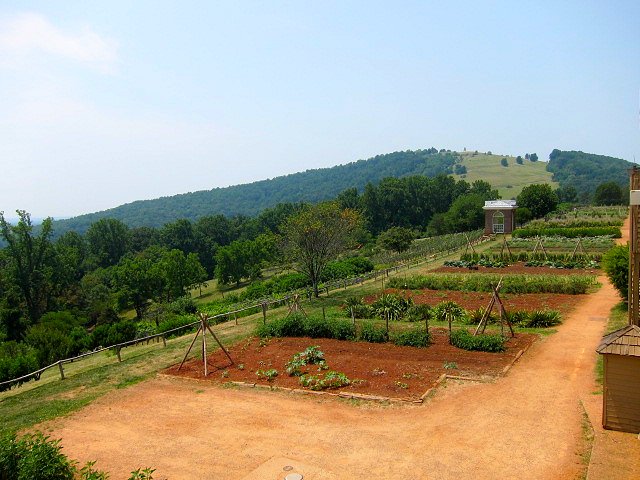
One of the things I discovered while touring Thomas Jefferson's gardens at Monticello, which I wrote about here, was that he was an enthusiastic grower and eater of peas. In fact, peas were his favorite vegetable and he planted them repeatedly during his gardening years at Monticello between 1767 to 1824. Jefferson dedicated three entire "squares" to growing peas, and grew an astonishing twenty-three varieties, seeds for which were purchased from his favorite seedsman Bernard McMahon.
What intrigued me most about Jefferson's love of peas was the story of the yearly pea contest in which he engaged with other gentlemen farmers of the area. The winner was declared when a farmer produced the earliest crop of peas for the year. The winner would then invite the other participants to share in a meal that would include, naturally, the winning peas. George Divers, a friend of Jefferson's, was always the annual champion of the contest, a proud accomplishment indeed. It is said that the year Thomas Jefferson produced the first pea, he was loath to reveal his victory so as not to hurt his friend's pride.

Pisum sativum "Prince Albert", an attractive heirloom pea seed packet purchased at Monticello, Thomas Jefferson's home in Virginia
Photo: Chronica Domus
I think it would have been a great lark to have joined in on the fun of this competition if I had been a neighbor of Jefferson's (were there gentlewomen farmers in his day I wonder?). So, when perusing the racks of seeds for sale at Monticello's gift shop, harvested from the gardens there, I naturally included a packet of English garden peas among my purchases. I was excited to take these back to my small garden in California and see if I too could cultivate peas, an endeavor I had as yet to try.

The delicate white blossoms of the Prince Albert heirloom pea appear as white butterflies at rest
Photo: Chronica Domus
I chose an heirloom pea that is said to be indistinguishable from Pisum sativum "Early Frame", a variety that was grown at Monticello annually between 1809 and 1824. The variety I selected, Pisum sativum "Prince Albert", was introduced to American gardeners from England in 1845 where it had been grown there for many years prior.

Young peas on the vine photographed in May, 2014
Photo: Chronica Domus
I planted eighteen seeds on March 17 to mark St. Patrick's day. These were, after all, green vegetables so what could be more appropriate. The seeds were sown around two pyramidal-shaped structures that I made using branches pruned from the fruit trees in my garden, and a few pieces of twine to secure the tops. Jefferson referred to these as "pea sticks" and they provide support for the young pea shoots and tendrils as they grow and scramble skyward. All but one of the seeds germinated. Half the seeds I planted were from the original seeds within the packet I bought back from Monticello in the summer of 2012. The other half were seeds I saved from the initial crop of peas I grew from those seeds last summer. I was curious to discover if the fresher seeds I had saved would grow into stronger and taller plants, therefore producing more pea pods, than the seeds from the Monticello packet that were now three years old since being harvested.

The vines are now laden with plump peas ready for harvesting
Photo: Chronica Domus
On June 3, with assistance from my daughter, we excitedly picked the first harvest. Our crop amounted to two hundred and fourteen plump little pea pods. We were delighted with our little bounty. There are several more pods remaining on the plants but those are not quite ready to be picked yet. Also, many white flowers at the tops of the plants have yet to bloom so over the next month or so, if the bees and the butterflies cooperate, we can expect another, albeit smaller crop. I noticed that both the newer seeds I harvested last year, and the original seeds I purchased, did equally well. They both grew to the same height (around five and a half feet), and they both held as many pea pods as each other.

The first crop of heirloom Prince Albert peas harvested on June 3, 2014
Photo: Chronica Domus
And, what of the contest? Well, I doubt very much I would have won the annual pea growing contest, even with the advantage of the milder climate I enjoy in California. It took me exactly seventy-eight days from sowing my seeds to harvesting them. An entry in one of Jefferson's gardening notebooks tells us that the "forwardest peas of February 20 come to table". He wrote that on April 24, 1767, which meant his peas were ready to be eaten in sixty-three days, assuming as was very likely the case, that the peas were picked the same day they were consumed. Clearly, this gentlewoman farmer is in no position to be hosting any winning feasts.

The peas after shelling
Photo: Chronica Domus

A closer view of a perfectly formed, plump pea pod encasing six fat little peas
Photo: Chronica Domus
What I was able to do, however, was host my own dinner with a bowl of our heirloom peas as our side vegetable. Of course, as Monticello tradition dictates, our dinner was eaten in the dining room around 4 p.m. The peas were served from an old Paris porcelain vegetable bowl, and eaten from plates to match. These pieces were all made during Jefferson's lifetime around the factories of Paris. I chose them to honor the fact that Jefferson likely ate from similar porcelain tableware. While stationed in France as Minister representing the United States, he became so enamored of French porcelain that he arranged for barrel loads to be shipped back to Monticello upon his departure from his post in Paris. Within those barrels were held a staggering one hundred and twenty plates along with the other service pieces he selected. His granddaughter, Ellen Coolidge, noted that it was not unusual for Jefferson to have his plate changed several times during the course of his dinner. Some of the surviving pieces of porcelain at Monticello are decorated with gilt bands and small springs of flowers.
It is indeed very satisfying to experience the same taste that Jefferson favored so much in his English peas. Prince Albert is a very different pea from those to which we have become accustomed today. Modern varieties are far sweeter than these heirlooms. This heritage pea can best be described as starchier and more akin to beans than peas. Delicious to be sure, when simply dressed with a good dollop of creamy butter, but an altogether different taste experience.

Prince Albert peas come to table on June 4, 2014 ready to be devoured as part of our dinner
Photo: Chronica Domus
If you too are interested in growing heirloom peas, or even hosting your very own pea growing competition, Monticello now sells their seeds via their web site. Of course, if you are as fortunate as I was and have an opportunity to visit the house and gardens in person, I believe you too will come away inspired and in awe of how well the man lived and gardened. It is, indeed, a most fascinating look into his world.
I hope I've inspired you to try your hand at sowing a few seeds which may afford you the experience of sampling the earth born flavors of late eighteenth and early nineteenth century vegetables.
Nota bene: I am neither paid nor do I receive recompense in exchange for applauding products or services within my blog. I do so because I enjoy them. If you are a kindred spirit, you too enjoy recommending nice things to fellow good eggs.