Wednesday, October 24, 2018

Exploring New Orleans: Part I of III

Chronica Domus
It won't take long for visitors to hear the familiar sounds of New Orleans as they amble
around the French Quarter on any given day or night
Photo: Chronica Domus


My husband and I have just returned from a very enjoyable visit to New Orleans, a city in the midst of celebrating its tercentennial anniversary.  As you can well imagine, a place as historically rich and culturally diverse  as New Orleans rightfully has plenty to celebrate.  It is a city I have longed to visit but somehow didn't until last week.  With a reputation for good food, interesting architecture, and a laid-back attitude, I was more than eager to discover the delights of the Big Easy.

After checking into a supremely comfortable room at the Windsor Court Hotel on a hot and humid afternoon, a refreshing drink was in order.  A Ramos Gin Fizz, one of the city's most famous cocktails, was just the ticket.  Luckily for us the famed Sazerac Bar was just a short walk away.  I could not think of a better place to cool down, unwind, and enjoy a slice of old-world New Orleans.

Chronica Domus
The Paul Ninas murals and white jacketed bartenders lend an air of yesteryear to
The Sazerac Bar's elegant ambiance
Photo: Chronica Domus


Suitably refreshed and ready to explore, we sauntered towards the French Quarter, an experience I shall not soon forget.  Looking around at our surroundings, we momentarily felt a sense of déjà vu.  Had we stumbled into a back street in Lyon France, or perhaps Spain, or even the West Indies?  The French Quarter is all of these places thanks to the architectural influences of its early settlers.  

Chronica Domus
The area around Bienville Place on Decatur Street reminded me of Europe
Photo: Chronica Domus


Chronica Domus
Place des Vosges in Paris or Jackson Square in New Orleans?
Photo: Chronica Domus


Chronica Domus
The French Quarter is famous for the many intricately fashioned iron balconies, or
galleries, found on many of its buildings
Photo: Chronica Domus


New Orleans is surrounded by water.  The steamboats that once navigated the mighty Mississippi river played an important part in why the area established itself as a world port.  Today, one can still spot a steamboat or two paddling down the river; here's The Natchez underway taking passengers on a night cruise.

Chronica Domus
Photo: Chronica Domus


The city's outlying bayous and wetlands offer a fascinating glimpse at the natural landscape surrounding New Orleans.  Built, in the main, at sea level, the city is keenly aware of the devastating consequences of floodwaters.  Pumps and levees work overtime to keep the area dry.

Chronica Domus
A whimsical drainpipe New Orleans style!
Photo: Chronica Domus


An excursion into nearby Cajun country and a tour of the swamps is a must for any curious visitor, especially so if one wishes to see the local wildlife up close and personal.

Chronica Domus
Into the swamp we go perched upon a small airboat expertly steered by
Captain Randy, a man who has spent his entire life around the bayou
Photo: Chronica Domus


Chronica Domus
Spanish moss-covered Taxodium distichum, or Bald Cypress trees, grow in brackish
swamp water and are only able to survive because of their ...


Chronica Domus
... protruding roots which allow for an exchange of gases at the "knees" which keep the trees alive
Photo: Chronica Domus 


Chronica Domus
Proud Cajun Captain Randy tells us that he left school at the age of twelve to work on his
family's bayou; exceedingly knowledgeable in matters relating to the fragile ecosystem,
swamp management, and the local fauna and flora (just ask him about the Nutria invasion
and the rapidly disappearing bayou), Captain Randy made our visit to the swamp not only educational but jolly good fun too (he is an excellent storyteller!)
Photo: Chronica Domus


Chronica Domus
Yes, it's true, alligators really do live in the swampy environs of New Orleans and
Captain Randy knows exactly where to find them
Photo: Chronica Domus


Back in the city, the best way to get around is either on foot or by boarding one of the handsome streetcars that have been rolling by every few minutes for the past one-hundred and fifty years.  We rode the streetcars twice during our stay in New Orleans; once up to City Park to tour a historic house that I'll be posting about next, and the other to the Garden District to view the many antebellum houses the area is famous for and the cemetery.

Chronica Domus
All aboard the city's famous streetcars
Photo: Chronica Domus


Chronica Domus
Because the water table is high in New Orleans, the deceased are interred in above-ground tombs
to avoid any unpleasant consequences of flooding
Photo: Chronica Domus


Chronica Domus
Quercus virginiana, or Southern live oak trees, are as  stately as the houses that line 
the streets of the Garden District
Photo: Chronica Domus


Chronica Domus
This incredible cast iron cornstalk fence can be seen
at Colonel Short's Villa in the Garden District
Photo: Chronica Domus


Of course, I should not fail to mention some of the local food that citizens and visitors alike enjoy in New Orleans.  The cuisines of the Creole and Cajun traditions dominate the restaurant scene.  As we happened to be in New Orleans on Friday, there was only one place to lunch:

Chronica Domus
Galatoires on Bourbon Street looks rather civilized from the outside until, that is,  ...
Photo: Chronica Domus


... one steps into the rowdy dining room during the madness that is Friday lunch
Photo: Chronica Domus


Lunching at Galatoires on Friday is a beloved local tradition.  The boisterous conviviality of the diners sitting cheek by jowl makes for a very entertaining but noisy environment.   Admittedly, it was all a tad too much for us out-of-towners so we happily ate our lunch in the upstairs dining room alongside other less spirited locals.

And, because we both have a sweet tooth, and the beignets were outstanding, we visited Café du Monde more times than I care to admit during our time in New Orleans.  There's good reason this place has been in business for the past century and a half.

Chronica Domus
Café au lait is the perfect accompaniment to delicious beignets
Photo: Chronica Domus


I shall miss beautiful New Orleans and its vibrant culture and friendly people.  With so much to offer, the Crescent City is well worth a repeat visit.  I look forward to that day not only with pleasure but with a little pep in my step (yes, I can still hear the sound of all those jazz bands playing in my head). 

In the next installment of this three part series, I look forward to showing you around a historic house situated along the banks of Bayou St. John.


Nota bene: I am neither paid nor do I receive recompense in exchange for applauding products or services within my blog.  I do so because I enjoy them.  If you are a kindred spirit, you too enjoy recommending nice things to fellow good eggs.

Sunday, October 14, 2018

A Successful Day At Auction & A Connection To An Important Welsh Ceramics Collection

Chronica Domus
Two auction attendees contemplate their bidding strategy
Photo: Chronica Domus


It has been an age since I was motivated enough to haul my caboose out of the house on a weekend morning to attend a live auction. One bright and sunny day last month, my husband and I did just that, taking our ringside seats at the hottest event in town.  Fellow ceramics collectors, clutch your paddles tight.  I am about to show you what it was that had me so revved up. 

While some attending the sale anticipated successful bids on the Picassos, Chagalls, or Dalis on offer, it was the numerous lots of English ceramics of the late-eighteenth to early-nineteenth century that lured me in like a fish to water.  Now, let me preface my scribblings by stating that in my part of the world, stumbling across a piece of early porcelain or creamware on my travels is a rare thing indeed.  These utilitarian (and fragile) articles were, after all, manufactured in potteries located on the other side of the world, on a small island over two centuries ago.  Bearing all that in mind, you can well imagine my delight at being confronted by the glorious vision captured in the photograph below:


Chronica Domus
A display case chock-full of early Wedgwood and Spode creamware table articles
spells danger for this particular addict collector
Photo: Chronica Domus


And, for admirers of early drabware ceramics, feast your eyes on this:

Chronica Domus
No, this is not a decorative arts museum's exhibit but the contents of a
single lot for sale at auction
Photo: Chronica Domus


Or, how about some neoclassically decorated English porcelain?  There was plenty of that to go around too.

Chronica Domus
Yes, please!
Photo: Chronica Domus


Chronica Domus
A Coalport tea service in a pretty orange and gilt pattern, circa 1820
Photo: Chronica Domus


After a brief confab with my husband, it was settled.  One of the creamware lots would - fingers crossed - be going home with us.  Spotting at least one other interested party circling the display cases and pacing between the creamware and the silver lots, we might be up against competition.

The lot that piqued our interest happened to be the final one of the early ceramics.  First under the auctioneer's gavel was the drabware, sold to an Internet bidder at, astonishingly, less than the bottom end of estimate.  Next, the first of two lots of Spode Greek pattern.  That too sold at a very reasonable hammer price. The creamware was next ...

Chronica Domus
Sold! ... Nine pieces of Wedgwood's Flute and Wreath pattern
Photo: Chronica Domus


Chronica Domus
Sold!... Wedgwood's Etruscan Pattern 42 in red and black and
Pattern 93 in yellow and black enamel, circa 1785 - 1790
Photo: Chronica Domus


Chronica Domus
Sold!... Five pieces (two out of range of this photograph) of Wedgwood's Pattern 94
Photo: Chronica Domus


Chronica Domus
Sold!... A large covered dish in brown and yellow enamel and an integral sauce tureen
Photo: Chronica Domus


Bidding was fast and furious and after several of the English porcelain lots came and went, it was time to take my paddle to hand and steel myself for the battle ahead. It helps, of course, to have the support of one's dear husband who is not such a bag of nerves when it comes to these matters. He usually wields the paddle but on this occasion, I found the strength to raise my own. As luck would have it, the experience was not at all intimidating. It did help that I was the only interested bidder. Sold! to the lady who almost fainted from the rush of excitement when the gavel finally dropped. We were going home with not one but two shelves full of delicious creamware plates and serving dishes (seen in the second top photograph of this post).

Chronica Domus
The winning lot!
Photo: Chronica Domus


Accompanying the stack of ten plates is a large shapely serving dish in the same hand-painted geometric pattern.  

Chronica Domus
It is hard to believe that this pristine Wedgwood serving dish is over 200 years old
Photo: Chronica Domus


Chronica Domus
A pair of Spode creamware supper dishes painted in a similar orange and black
enamel to the Wedgwood pieces are also included in the lot
Photo: Chronica Domus


The story of the winning ceramics doesn't quite end here.  A further serving dish included in the lot yielded a clue as to the previous owner.  It is always an exciting prospect to ponder where such humble household articles began their life, how they were used, and who cared for them along the way.  

Chronica Domus
Aha! A clue to where these dishes once lurked
Photo: Chronica Domus


Chronica Domus
Who might Grant-Davidson be I wonder?
Photo: Chronica Domus


A collector's label affixed to the underside of the dish prompted a little Internet sleuthing which soon revealed the identify of Grant-Davidson as the author of the following book:

Chronica Domus


Yes, that's right, my new old creamware dishes once formed part of the private collection of internationally recognized ceramics expert Mr. Wallace James Grant-Davidson.  

Mr. Wallace James Grant-Davidson proudly showing off part of his ceramics collection

Mr. Grant-Davidson, a historian and authority on Welsh pottery, was also an extraordinary lifetime collector of eighteenth and nineteenth century British porcelain and ceramics.  Following his death in 1999, Sotheby's was charged with dispensing the collection which included pieces of Whieldon, redware, stoneware, pratt-type wares, delftware, Staffordshire and Sunderland lustreware as well as creamware.  The collection was broken up into 270 lots that raised a sum of £110,975.

It is a rare privilege indeed to be privy to information on the provenance of newly acquired items at auction beyond, of course, what the seller provides the auction house.  This is why I was so pleased to discover the collection label attached to the underside of one of my plates.  The label led me to some fascinating information released by Sotheby's in the run up to the sale.  It identifies exactly where these dishes last resided during their two-hundred year history:

"The whole house was decorated with the china", Mrs. Margaret Grant-Davidson said; "every room had pieces on the walls, it covered the walls in the study, the bedroom, the dining room and even up the stairs!  My husband was a true collector, he brought what he liked.  I was married to him for more than 60 years and he was so meticulous and kept everything.  It is taking me a long time to sort things out and I am still finding things that I never knew we had.  I have kept many items as the house would be bare otherwise". 

It is pleasing to imagine that a humble Welsh house in Swansea was once home to such an extraordinary and well-loved collection of ceramics.  And now, here in my own humble abode, half way across the world, Mr. Grant-Davidson's dishes have somehow found their way to me.  I wonder where they'll end up next?  Until that day dawns, I look forward to using and enjoying my creamware, and setting it atop my period appropriate English mahogany dining table, alongside period glassware and silver.  Who knows, perhaps table and plate might have already met at a long-past luncheon or dinner party. 

Now, if you'll please excuse me, I'm off to hatch a plan for my creamware's coming out party ...

Sunday, September 23, 2018

A Visit to Gore Place

Nota bene: While poking around the back-of-house section of my blog recently, I was surprised to discover an unpublished post I wrote last summer following my visit to Boston and upstate New York.  Here is that post today for your reading pleasure.


I can't recall which book it was that I first saw an interior photograph of Gore Place, the 1806 Federal-era grand country estate in Waltham, Massachusetts.  Since that first sighting, the house has been on my "must see" list.  As luck would have it, Gore Place is just a stone's throw from Boston so I took the opportunity to visit with my family on our way to upstate New York back in late-June.

Chronica Domus
Photo: Chronica Domus


Upon arrival, we were enthusiastically herded greeted by Rocket, the resident Border Collie dog.  Rocket forms part of Gore Place's welcoming committee along with this gentleman:

Chronica Domus
Please meet Mr. Thom Roach
Photo: Chronica Domus


Our tour of the house and sprawling grounds was patiently and knowledgeably orchestrated by Mr. Thom Roach who delighted in the fact that we were an eager bunch bursting with questions about the house and its contents.  As the sole participants of his tour, we were fortunate indeed to have Mr. Roach's undivided attention.  "For a historic house", he tells us "Gore Place happens to be a little under the radar".  Perhaps by writing about it here on Chronica Domus, all that might one day change.

The bucolic fifty acre estate belonged to Christopher Gore, a prominent lawyer and politician, and his wife Rebecca.  Mrs. Gore was very influential in the design of the house and worked with Jacques Guillaume Legrand, a Parisian architect, to realize her dream of creating a stylish and comfortable country retreat. Much of Gore Place's furniture was made locally and remains in the house today. Visitors can identify these pieces by the informational tags attached to them.

Entering the house through the east door, we step into an inviting entrance space complete with an elegant curved cantilevered staircase. Mr. Roach points out evidence of an early version of a central heating vent tucked beneath the staircase.

Chronica Domus
Gore family portraits line the staircase walls
Photo: Chronica Domus


We are then ushered into the Great Hall.  This is the space I had seen photographed in a book long ago, and which had stirred my desire to one day make a pilgrimage to Gore Place.  In that photograph, the hall was set up as a dining space, complete with a Chinese export porcelain laden table, klismos chairs, and French Empire candelabra atop twin pier tables positioned in front of mirrors to capture the glow of candlelight.  Stepping into the Great Hall today, I was somewhat taken aback by its eye-popping transformation.  Save for the distinctive floor pattern, I barely recognized the place!  Here is the hall today ...

Chronica Domus
One of two fireplaces that heats Gore Place's Great Hall during cooler weather
Photo: Chronica Domus


... and this is how it looked around the time I saw it photographed in a book many years earlier:

Chronica Domus
Photo: Damie Stillman
Source


Chronica Domus
The Great Hall set up as a dining space much as it looked when I first
espied it in a book long ago
Source


The Great Hall has metamorphosed into a far more vibrant space due to the recent addition of the bold pink and blue block-printed French wallpaper and border, recreated from a document found in the house.  The hall, I learned, now appears as it did shortly after the house was built in 1806.

Chronica Domus
The Great Hall's floor is made of cooling Pennsylvania King of Prussia marble
Photo: Chronica Domus


If I am perfectly honest, I much prefer the soothing tone of the painted walls, as historically inaccurate as that may be.  Those Federal-era decorators were no shrinking violets, that's for sure!

Next, we enter the oval-shaped drawing room.  The triple-hung windows, when not shuttered as on the day we visited, reveal south-facing views of verdant lawns beyond.

Chronica Domus
This is one of two handsome Federal mahogany sofas gracing the oval drawing room
Photo: Chronica Domus


Mr. Roach delighted in revealing to us Mrs. Gore's china closet, ingeniously situated between the oval walls shared by the Great Hall and the drawing room.  If that's not an efficient use of an awkwardly-shaped space, I don't know what is.

Chronica Domus
Tucked between the drawing room and the Great Hall is a small china closet whose shelves groan with Chinese Export and Old Paris Porcelain - Mrs. Gore placed the closet there for efficiency and for its proximity to the basement kitchen
Photo: Chronica Domus


The library is located in the east wing of the mansion and is a particularly comfortable room in which to study.  This is due to the plentiful natural light that streams in through four large windows.  The handsome fireplace was carved by Samuel McIntire.

Chronica Domus
The nine foot round mahogany library table dominates the room and provides
ample space for studious pursuits
Photo: Chronica Domus


Chronica Domus
A pair of silhouettes hang on the library's walls - might they 
possibly be Mr. and Mrs. Gore?
Photo: Chronica Domus


In a nearby small parlor, a table is set with seasonal ingredients available to the family in 1806.  This is the salad course.

Chronica Domus
Photo: Chronica Domus


Chronica Domus
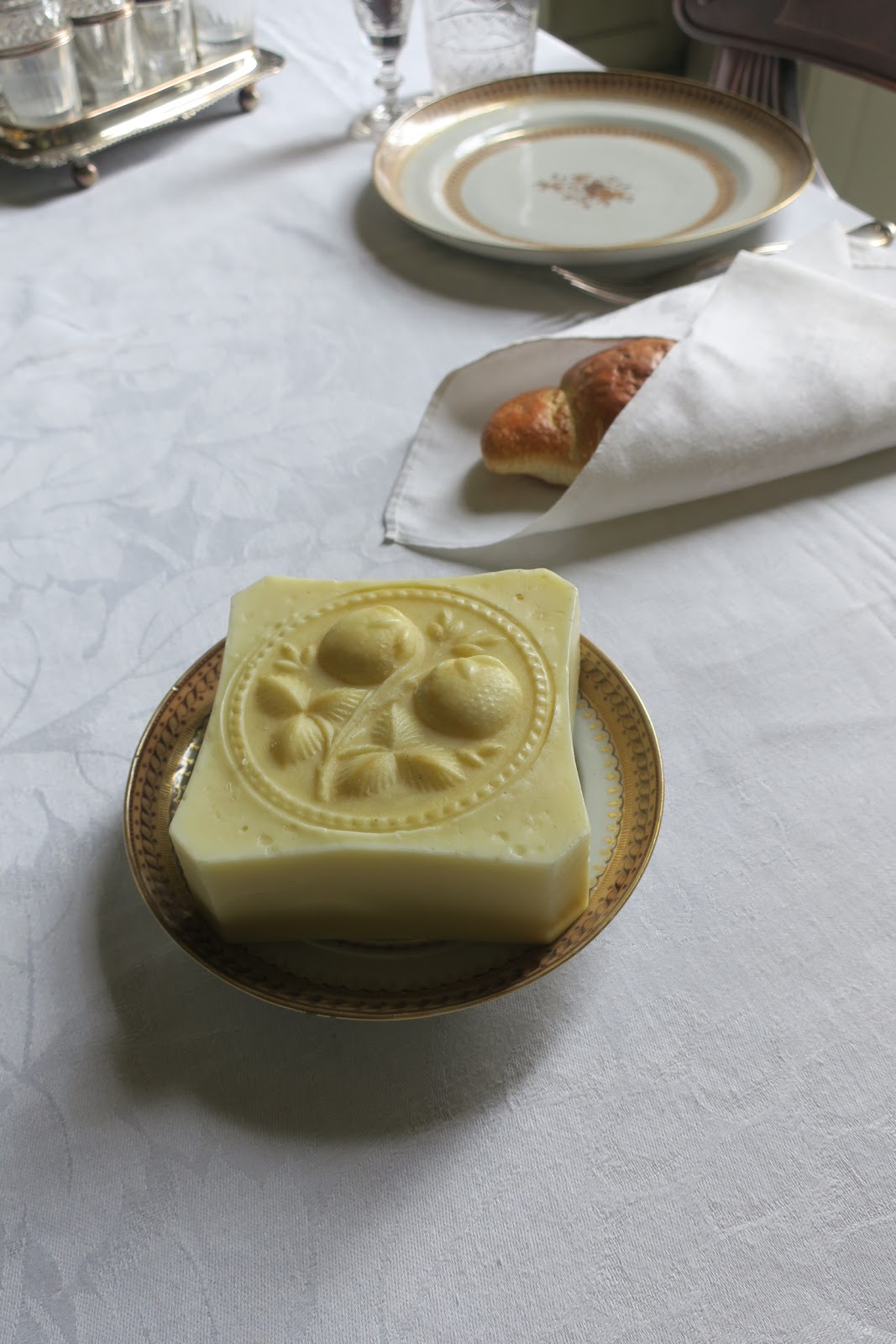
If only every slab of fresh creamy butter was such a work of art!
Notice how the bread roll is tucked into the napkin, exactly as Mr. Gore's butler,
Mr. Robert Roberts, would have placed it
Photo: Chronica Domus


When we first arrived at Gore Place, Mr. Roach ushered us into the house through the east door.  We now stand at the west entry of the house which was primarily used by Gore Place's visiting tradesmen.  The room is sparsely but beautifully decorated with silver candle sconces, Windsor chairs, two clocks, and few other embellishments.  I rather liked this unfussy space.  The flooring is constructed of the same King of Prussia marble as is found in the Great Hall.

Chronica Domus
 Photo: Chronica Domus


Chronica Domus
Keys found around the property hang on what appears to be a decorative, and
covetable, brass George Washington curtain tie back
Photo: Chronica Domus


Below shows the small room that Mr. Gore utilized as his office.  With its cheery apricot colored walls and the four windows filling the room with light, I can well understand Mr. Gore's desire to spend time here.  Tackling the business of bill paying and other administrative tasks would certainly become a more pleasurable undertaking when conducted from the confines of this cozy and well appointed office.  

Chronica Domus
Mr. Gore's comfortably furnished office
Photo: Chronica Domus


Below shows yet another dining table.  This room is where the family ate their breakfasts.  Boiled eggs are on this morning's menu.  Interestingly, when the Gores lived in the house, eggs were a seasonal food item and unavailable during the winter months.  

Chronica Domus
A striking floorcloth is placed atop the gray painted floorboards in the breakfast room
Photo: Chronica Domus


Chronica Domus
Time to go upstairs
Photo: Chronica Domus


With all the setting of tables, stoking of fires, and running up and down flights of stairs, is it any wonder that the poor butler was so exhausted!  Fear not, for he enjoyed his own special place to sooth his weary feet upstairs on the mezzanine level in the butler's chamber.

Chronica Domus
A foot bath at the ready to receive the aching feet of Mr. Robert Roberts, Mr. Gore's trusty butler
Photo: Chronica Domus


Every butler's duty revolves around his master and attending to his wardrobe needs.  Below is a corner of Mr. Gore's dressing room.  It is here that Robert Roberts assisted Mr. Gore with his daily dress and with the care of his master's wardrobe.

Chronica Dous
Mr. Gore's dressing room 
Photo: Chronica Domus


Chronica Domus
An early-nineteenth century popcorn maker at the ready in one of the upstairs rooms
Photo: Chronica Domus

It's all fun and games as we walk into the oval billiards room, situated directly above the downstairs oval drawing room.  The room happens to hold the second oldest surviving billiards table in the United States.

Chronica Domus
The billiards table fills almost the entire oval room and looks particularly smart
with its epaulet-like pockets
Photo: Chronica Domus


Chronica Domus
Mr. Gore purchased the billiards table in 1805 and it remained in this room
until 1910 when it was sold to a local family for $15 - it returned home in
1935 when the house became a museum
Photo: Chronica Domus


Chronica Domus
A tranquil corner of the guest bed chamber with a beautiful painted wallpaper that
would not look so out of place in a modern interior
Photo: Chronica Domus


Making our way through the remainder of the upstairs bed chambers and sitting room, we again find our way downstairs via the main staircase.

Chronica Domus
Although not so obvious in this photograph, the stair treads are painted to resemble the gray 
and white marble of the entrance hall's floor which was quarried in Pennsylvania
Photo: Chronica Domus


Once outside the house, Mr. Roach walks us over to the immaculately restored carriage house.  Built in 1793, the structure housed wagons and horse-drawn carriages.

Chronica Domus
Photo: Chronica Domus


The carriage house is divided into four sections; a tack room, a harness room, the horse stalls, and a carriage room.  Believe it or not, the structure has endured two moves in its long history and is now, thankfully, back in its original spot on the property.

Chronica Domus
The tack room is as neat as a pin
Photo: Chronica Domus


Chronica Domus
Any horse would be delighted to be put up in these stalls
Photo: Chronica Domus 


Chronica Domus
Photo: Chronica Domus


Chronica Domus
A country carriage, along with the Gore's city carriage sit in the carriage house today
Photo: Chronica Domus


Mr. Roach's pride in showing us around Gore Place was more than evident, and his enthusiasm was contagious.  We thoroughly enjoyed our visit thanks to him and left with a better understanding of how life was lived in this marvelous Federal-era country estate.  Our only regret was not setting aside enough time to explore the remainder of the property and farm.  There is always next time I suppose.

Chronica Domus
Borrowing ideas from the English landscape style of Humphry Repton, the Gore's
planted broad lawns and many trees on the property
Photo: Chronica Domus


Please do make it a point to visit Gore Place when you next find yourself in nearby Boston.  It is a mere thirty minute car ride from the bustle of the city and well-worth your time.

Gore Place & Farm
52 Gore Street
Waltham, Massachusetts
Tel: 1 781 894 2798
https://goreplace.org/


Related Posts Plugin for WordPress, Blogger...