Sunday, June 15, 2014

The Tale of a Naughty Laptop


My morning started with coffee and cursing.  The cursing was emanating from my husband who was thoroughly peeved off with our laptop that was not behaving to his liking.  To his insistence, the computer was making decisions on its own, such as opening pages and pushing command buttons on various websites.  Of course, I scoffed dismissively and returned to my coffee.

Fast forward to the afternoon following on from a wonderful lunch, it was my turn at the keyboard.  I began working on the outline for a future post when suddenly, what were imaginary problems when they involved my husband earlier in the day, suddenly became my reality.

It seems our laptop saw fit to publish my working model gibberish, a fact that escaped my notice for five hours.  Upon returning from a visit with friends, I was mortified to discover this rather red face inducing development and swiftly deleted the posting.

I suppose this is all my fault as there have been plenty of warnings in the media of late regarding the fact that Windows XP is no longer supported by Microsoft, thus subject to some rather nasty digital illnesses.  I think mine just caught a bug. 

This was definitely the straw that broke the camel's back so we are now in the market for a less vulnerable laptop.  Please stay tuned as normal service will resume shortly.

Have all of you non-Mac users updated your computers from Windows XP? 


Monday, June 9, 2014

An Edible Antique: Recreating A Jeffersonian Pea Contest

Chronica Domus
Readying the table for dinner with the first crop of heirloom Prince Albert peas
Photo: Chronica Domus


One of the things I discovered while touring Thomas Jefferson's gardens at Monticello, which I wrote about here, was that he was an enthusiastic grower and eater of peas.  In fact, peas were his favorite vegetable and he planted them repeatedly during his gardening years at Monticello between 1767 to 1824.  Jefferson dedicated three entire "squares" to growing peas, and grew an astonishing twenty-three varieties, seeds for which were purchased from his favorite seedsman Bernard McMahon.

What intrigued me most about Jefferson's love of peas was the story of the yearly pea contest in which he engaged with other gentlemen farmers of the area.  The winner was declared when a farmer produced the earliest crop of peas for the year.  The winner would then invite the other participants to share in a meal that would include, naturally, the winning peas.  George Divers, a friend of Jefferson's, was always the annual champion of the contest, a proud accomplishment indeed.  It is said that the year Thomas Jefferson produced the first pea, he was loath to reveal his victory so as not to hurt his friend's pride.

Chronica Domus
Pisum sativum "Prince Albert", an attractive heirloom pea seed packet purchased at Monticello, Thomas Jefferson's home in Virginia
Photo: Chronica Domus


I think it would have been a great lark to have joined in on the fun of this competition if I had been a neighbor of Jefferson's (were there gentlewomen farmers in his day I wonder?).  So, when perusing the racks of seeds for sale at Monticello's gift shop, harvested from the gardens there, I naturally included a packet of English garden peas among my purchases.  I was excited to take these back to my small garden in California and see if I too could cultivate peas, an endeavor I had as yet to try.

Chronica Domus
The delicate white blossoms of the Prince Albert heirloom pea appear as white butterflies at rest
Photo: Chronica Domus


I chose an heirloom pea that is said to be indistinguishable from Pisum sativum "Early Frame", a variety that was grown at Monticello annually between 1809 and 1824.  The variety I selected, Pisum sativum "Prince Albert", was introduced to American gardeners from England in 1845 where it had been grown there for many years prior. 

Chronica Domus
Young peas on the vine photographed in May, 2014
Photo: Chronica Domus


I planted eighteen seeds on March 17 to mark St. Patrick's day.  These were, after all, green vegetables so what could be more appropriate.  The seeds were sown around two pyramidal-shaped structures that I made using branches pruned from the fruit trees in my garden, and a few pieces of twine to secure the tops.  Jefferson referred to these as "pea sticks" and they provide support for the young pea shoots and tendrils as they grow and scramble skyward.  All but one of the seeds germinated.  Half the seeds I planted were from the original seeds within the packet I bought back from Monticello in the summer of 2012. The other half were seeds I saved from the initial crop of peas I grew from those seeds last summer.  I was curious to discover if the fresher seeds I had saved would grow into stronger and taller plants, therefore producing more pea pods, than the seeds from the Monticello packet that were now three years old since being harvested.

Chronica Domus
The vines are now laden with plump peas ready for harvesting
Photo: Chronica Domus


On June 3, with assistance from my daughter, we excitedly picked the first harvest.  Our crop amounted to two hundred and fourteen plump little pea pods.  We were delighted with our little bounty.  There are several more pods remaining on the plants but those are not quite ready to be picked yet.  Also, many white flowers at the tops of the plants have yet to bloom so over the next month or so, if the bees and the butterflies cooperate, we can expect another, albeit smaller crop.  I noticed that both the newer seeds I harvested last year, and the original seeds I purchased, did equally well.  They both grew to the same height (around five and a half feet), and they both held as many pea pods as each other.

Chronica Domus
The first crop of heirloom Prince Albert peas harvested on June 3, 2014
Photo: Chronica Domus


And, what of the contest?  Well, I doubt very much I would have won the annual pea growing contest, even with the advantage of the milder climate I enjoy in California.  It took me exactly seventy-eight days from sowing my seeds to harvesting them.  An entry in one of Jefferson's gardening notebooks tells us that the "forwardest peas of February 20 come to table".  He wrote that on April 24, 1767, which meant his peas were ready to be eaten in sixty-three days, assuming as was very likely the case, that the peas were picked the same day they were consumed.  Clearly, this gentlewoman farmer is in no position to be hosting any winning feasts.

The peas after shelling 
Photo: Chronica Domus


Chronica Domus
A closer view of a perfectly formed, plump pea pod encasing six fat little peas
Photo: Chronica Domus


What I was able to do, however, was host my own dinner with a bowl of our heirloom peas as our side vegetable.  Of course, as Monticello tradition dictates, our dinner was eaten in the dining room around 4 p.m.  The peas were served from an old Paris porcelain vegetable bowl, and eaten from plates to match.  These pieces were all made during Jefferson's lifetime around the factories of Paris.  I chose them to honor the fact that Jefferson likely ate from similar porcelain tableware.  While stationed in France as Minister representing the United States, he became so enamored of French porcelain that he arranged for barrel loads to be shipped back to Monticello upon his departure from his post in Paris.  Within those barrels were held a staggering one hundred and twenty plates along with the other service pieces he selected. His granddaughter, Ellen Coolidge, noted that it was not unusual for Jefferson to have his plate changed several times during the course of his dinner.  Some of the surviving pieces of porcelain at Monticello are decorated with gilt bands and small springs of flowers.

It is indeed very satisfying to experience the same taste that Jefferson favored so much in his English peas.  Prince Albert is a very different pea from those to which we have become accustomed today.  Modern varieties are far sweeter than these heirlooms.  This heritage pea can best be described as starchier and more akin to beans than peas.  Delicious to be sure, when simply dressed with a good dollop of creamy butter, but an altogether different taste experience. 

Chronica Domus
Prince Albert peas come to table on June 4, 2014 ready to be devoured as part of our dinner
Photo: Chronica Domus


If you too are interested in growing heirloom peas, or even hosting your very own pea growing competition, Monticello now sells their seeds via their web site.  Of course, if you are as fortunate as I was and have an opportunity to visit the house and gardens in person, I believe you too will come away inspired and in awe of how well the man lived and gardened.  It is, indeed, a most fascinating look into his world.

I hope I've inspired you to try your hand at sowing a few seeds which may afford you the experience of sampling the earth born flavors of late eighteenth and early nineteenth century vegetables.

Nota bene: I am neither paid nor do I receive recompense in exchange for applauding products or services within my blog.  I do so because I enjoy them.  If you are a kindred spirit, you too enjoy recommending nice things to fellow good eggs.

Tuesday, June 3, 2014

Pennies From Heaven

Chronica Domus
No, this is not my tip for serving dinner to my family, this is a tally of found coins for the year
Photo: Chronica Domus

I have always been a walker, at least as far back as my failing mind can recall.  My mother doesn't quite remember when exactly I found my legs as a toddler, but I'm sure that when I did, I ambled and sashayed with abandon.  I recall early sturdy and sensible walking shoes always being purchased at Clarks' flagship store on Regent Street in London.  This was certainly a fun adventure for us children being that our feet were always measured using their innovative electronic sizing machine.  The contraption insured the best possible fit in terms of width and length and assured my mother that we children would be kitted out in the best quality shoes she could afford.

Chronica Domus
As a child Chronica Domus was very familiar with these styles of shoe

I am convinced my love of walking has something to do with the fact that I was born in England, a nation that claims walking as its most popular outdoor recreational activity. Walkers in Britain are even granted special walkers' rights enabling them to cross footpaths on both public and private lands.

The British walk for the sheer joy of it, taking in the air and sights of both city and countryside, decked out in their comfortable walking shoes and perhaps a waterproof jacket. Americans, at least in my part of the country, walk for sport in their yoga togs, hurriedly traversing their ground, and constantly checking their heart monitors or pedometers between refreshing sips of water from their bottles.  It is all very exhausting!

My first post-college job required that I travel to London from my home in Kent.  This was a grueling daily commute involving a motor coach and several trains operated by London Underground, as well as walks in between the two modes of transportation.  All this before I even reached my office at 8.45 a.m.  The entire commute was done in reverse during the evening mad rush to get home.  I probably walked at least four miles per day during both journeys to and from work.

Chronica Domus
The Embankment tube station, part of my daily commute into the office

My honeymoon was spent walking for a week in the pristine Emigrant Wilderness, situated in the Sierra Nevada mountains.  This was an entirely new experience for me and one that meant I had to negotiate the terrain of steep granite ridges and mountains (a rare sight in England), verdant meadows and lakes.  That was probably the toughest and longest walk I had ever undertaken, a fact that stands true to this day over two decades later.

When I adopted my first dog upon moving to my new country, I undertook the pleasures of exercising her twice a day.  A short walk in the morning, before leaving for the office, and a more leisurely one at the conclusion of the day.

During my lifetime of walks I have often spotted coins laying about in the streets and roadways, a penny here or a penny there.  I instinctively pick them up.  Will these pennies bring me luck, as the rhyme states?  "Find a penny, pick it up, all day long you'll have good luck".

The first time I came across found money I was no more than a child of nine, playing at the local park.  I recall the fiver wrapped around a scrunched up hand-written note instructing the fishmonger to fulfill "four orders of cod and chips, please".  Surely, a child on an errand for his mother must have dropped the note and money on his way to buy dinner for the family. I felt a sense of sadness for the child. Dinner would not be served in the form of fish and chips that evening but I had no way of knowing to whom I might return the money.

Chronica Domus
A view of Main Street, Jackson, California where we found our loot (note: not much has changed since the 1930's, apart from the motor cars)

The greatest amount of money I ever found was an astonishing nine-hundred dollars, located just outside the door of a small bank in the gold rush town of Jackson, California.  I was with my husband and some friends, and we had traveled to Amador county to spend the weekend at a bed and breakfast and to enjoy countryside walks and nearby towns. Obviously, it did not take us long to conclude that a customer of the bank had withdrawn the money and accidentally dropped it as they were leaving the building.  We stepped inside the bank and made inquiries of the tellers.  We were told an elderly gentleman had taken the money from his account and had only just left the establishment.  We thanked the tellers and set out to find the man in hopes of returning the cash.  It was an easy task as we immediately spotted the gentleman looking bewildered and upset.  We approached him and asked if he needed assistance.  The poor dear explained that he had just lost his son in a tragic motor car accident and had come to the town of Jackson to make funeral arrangements.  The money we had found was intended to help with those costs.  We were all dumbfounded upon hearing his unfortunate tale, but felt terribly satisfied we were able to return the money to the rightful owner.

Last June, I finally decided to seek the answer to a nagging question; precisely how much money do I come across during my day-to-day walks.  I set myself the task of picking up every coin or note I found for exactly one year.  At the end of it, I would have my answer.

At first, I found the odd penny strewn about on the pavements of my regular dog walking route.  Then, I noticed that shortly after the local schools had closed for the duration of the summer holiday, the coins I found were of larger denominations.  Quarters, dimes, and nickels had been dropped from the pockets and little hands of excited school-aged children on their way to the local shops, or perhaps a friend's  home, or to spend the day playing at the local park.  Incidentally, June was the month I found the most coins, followed by July and August.  After the schools were once again in session, my luck had run dry and I was back to picking up the occasional penny.  I did not find any notes during my twelve month experiment, although I did find eleven single dollar bills that were bundled together in a parking garage right before I started my experiment (so those don't count). 

I have just tallied the coins, exactly twelve months to the day after starting my experiment, and found I had collected a grand total of one dollar and fifty-five cents.  This was not exactly a windfall, I'll admit, but it was enough (barely) to buy a small cup of coffee from the local coffee shop.  And, as for luck, I'm not sure if finding all of those pennies has made me a luckier girl or not.  It has certainly trained my eyes to dart about obsessively upon the ground I tread.  I must stop that now.

Do you enjoy walking, and have you found anything of value during your everyday comings and goings?

Thursday, May 29, 2014

What's Blooming Inside: A Coincidence of Color

Chronica Domus
Icelandic poppies and ranunculus, held in a nineteenth century leech jar, impart a dash of color to the drawing room
Photo: Chronica Domus


Fresh flowers are a weakness of mine and I attempt whenever possible to brighten the house with at least a grouping or two weekly.  The arrangements need not be large and showy, when simple and understated will do nicely, as seen in an earlier post here. They do, however, need to be as fresh as possible and fit the room in which they are to be displayed.

Two weeks ago, we attended the memorial service of my husband's great aunt who had recently passed away at the grand old age of 91. The family member that had organized the luncheon following the service generously sent me home with the small vase of flowers that had been displayed at our table.  The arrangement was nice enough, but the stars, the Icelandic poppies (Papaver nudicaule), were obscured by the fluff that typically accompanies most run-of-the-mill florist arrangements.  I am sure you are familiar with the stuff; bits of fuzzy greenery, gypsophila, grasses etc.

Chronica Domus
One of a pair of posies made with orange tulips, zesty ranunculus, and green viburnum macrocephalum, graces the dining table during a recent Mothering Sunday luncheon
Photograph: Chronica Domus 


Upon our return home, I plucked the crepe-paper-like poppies from their vase, cut down their wiry fuzzy stems, and placed them in a small 19th century leech jar that I often use for diminutive arrangements.  To the sorbet-colored poppies I added some ranunculus, in complimentary shades of orange and melon, that were already at hand and had formed part of two flagging posies which I had assembled for a recent Mother's Day luncheon in honor of a dear senior neighbor friend.  The end result, I think, is really rather lovely.  Don't you agree? The poppies are clearly and rightfully the stars of the show, just as they should be. I've named this my coincidence of color arrangement.  Not only did my existing ranunculus blend well with the beautiful Icelandic poppies, but when I placed the vase on a table in the drawing room, the effect was instantly magnified by the zesty color of the upholstered side chair.  A coincidence of color indeed, and a lovely way of prolonging our memories of great aunt Alberta with fondness and grace.

Wednesday, May 21, 2014

Lunch At Bouchon

Chronica Domus
A whimsical presentation of Bouchon's business cards
Photo: Chronica Domus


Nota bene: I had meant to publish this post in mid-April, but it somehow got buried within the other posts I am working on.  I hope you enjoy it.

It was a crisp Saturday morning in the city, dampened by a light mist, and with just enough of a chill to warrant the use of a jacket.  Forgoing the usual Saturday morning routine of stopping by the farmers' market and stocking up on the week's supply of vegetables and fruits, I decided instead that an escape to the country would be the order of the day.  It had been several month since last visiting the Napa Valley so the three of us hopped into the family car and away we drove, across the Golden Gate bridge, and onto pastures green and yellow.

I adore visiting the environs of Napa at any time of year but I especially savor the drive during the early spring months.  To witness firsthand the swathes of vibrant mustard yellow flowers of rapeseed that blanket the landscape as far as the eye can see is a special privilege indeed.  It really is quite a sight, depending on whether your timing is impeccable, of course. Unfortunately, on this particular journey, we just caught the tail end of the show as there were fewer flowers to woo us than in years past.  However, dotted about here and there were dazzling orange poppies, California's state flower, punctuating the green hills and pastures.  Nature certainly knows how to put on a spectacle in spring, no matter the color.

Chronica Domus
Grapevines and green hills everywhere you look
Photo: Chronica Domus


Meandering along the tree lined highways dotted with wineries and neat rows of grapevines, one felt an overwhelming sense of pleasure that everything was right with the world.  How could it not be?  This is truly one of the most spectacularly picturesque places in the entire Bay Area, a place already saturated with much natural beauty; a jewel polished off with a favorable climate, world-class viticulture, exceptional culinary experiences attained through sensitive agricultural practices, and picture perfect towns.  This must surely be what Eden on earth looks like.  Well, at least in this corner of the world certainly.

Chronica Domus
The exterior of Bouchon housed in an historic brick building
Photo: Chronica Domus


Approaching 1 p.m., with warnings from grumbling tummies, we stopped for lunch in Yountville, a little town that is home to a rather large star of the restaurant world.  Our destination on this occasion was Bouchon, Thomas Keller's little bistro, just a few minutes walk from his other more famous landmark restaurant, The French Laundry.  You may already know of Mr. Keller as he has received some of the highest accolades awarded to any American chef, and his restaurants, including New York's Per Se, are perennial favorites on the world's top restaurant lists.

Bouchon, opened in 1998, is Mr. Keller's little Parisian-esque outpost where one can dine very well on honest French bistro fare, served at either lunch or dinner, without enduring months of wait for a table (I hear there is a six month lead time for dinner reservations at The French Laundry).  On this occasion, we were fortunate to have been seated within a few minutes of our arrival, with no prior reservation, at an already packed restaurant.

Chronica Domus
The beautiful zinc-lined bar displaying a selection of the day's Fruits de Mer
Photo: Chronica Domus


Bouchon is housed within a brick building constructed in the 19th century, and is fronted by an outdoor seating area, of which many diners chose to take advantage.  The indoor dining room is flooded by a profusion of natural light that streams through the floor-to-ceiling casement windows and by the multitude of mirrors lining the walls. At the center, the space is anchored by an enormous lush potted palm. Our table was located besides the palm which afforded us an excellent view of the lively and energetic comings and goings of the busy dining room.  A very attractive zinc-lined bar, stocked with the usual top shelf spirits and a variety of locally produced wines, dominates the corner opposite the entrance. The bar also doubles as a showcase for tempting marine treats on offer. So, if oysters, lobsters, crabs, mussels, and shrimp are your thing, you've no doubt come to the right place.

Chronica Domus
The enormous potted palm reaches for the ceiling
Photo: Chronica Domus


For us, every successful lunch begins with a round of refreshing gee and tees, and that is precisely what we ordered to kick off the proceedings.  Our daughter, of course, is not yet of drinking age so appropriately chose a suitable beverage befitting her years.  Wisely, we decided against ordering a second round of gee and tees, as we were, after all, in the heart of wine country and would have hated to forgo the opportunity of sampling a great locally produced white or red with our meal.  How funny to think back to the days before moving to America when I was completely in the dark about California's world-class wines.  My family in England always favored wines from France, Germany, Spain, and Italy, so I had foolishly assumed anything beyond the old world would be of no match. So, it was with much joy and pleasure that I discovered the delights of the Napa Valley, just a short distance from my new home, through the numerous tastings at wineries over the years. The region has produced wine since the 1850's and is now considered one of the premiere wine regions of the world.

Chronica Domus
Gee and tee at the ready, menu to hand, and crusty pain d'epi to munch upon
Photo: Chronica Domus


Bouchon's menus are printed on brown paper and are to be found at each place setting, folded over the fresh cloth napkins.  Our efficient and friendly waiter, traditionally dressed in a long white apron, black waistcoat and tie, was quick to point out the day's specials, one of which immediately caught our attention. The menu is seasonally focused, but the backbone of bistro fare dominates; steak frites, steak tartare, escargot, duck confit, salads, vegetable dishes, and soups.

As asparagus is currently at its peak, sourced locally from the Sacramento-San Joaquin river delta, we ordered the salade d'asperges which looked very artful as it arrived on its plate, accompanied by a melange of spring vegetables in a light vinaigrette.  Perfectly tender yet still crisp, it was a delicious start to our luncheon.

Chronica Domus
A picture perfect presentation of asparagus
Photo: Chronica Domus


My husband and daughter rather fancied the coddled eggs, one of the special dishes of the day, and who could blame them.  It must have been a popular choice among today's hungry diners because as soon as our order was taken, the waiter erased it from the slate of specials.  I enjoy a good decadent egg dish and this one had me wavering between it and the trout. Served in little iron lidded cocottes, the eggs were faultlessly cooked, bathed in rich cream, fresh herbs, spinach, mushrooms, and chunks of Maine lobster, with a surprise bread-like pastry bottom.  I could not help but swipe a few bites from my daughter who enjoyed the dish immensely and has developed quite a mature palate for a twelve year old.

Chronica Domus
Sublimely prepared coddled eggs with Maine lobster, spinach and mushrooms
Photo: Chronica Domus


I selected the slightly less calorific rainbow trout with haricots verts and toasted almonds in brown butter, and immediately counteracted the effects of my somewhat healthy choice with an order of pommes frites.  How do those elegant French ladies stay so stick-slim I wonder? The accompanying aioli did not help my cause, but oh my heavens, how delicious it all was!

Delectably fresh trout heaped with haricots verts and toasted almonds
Photo: Chronica Domus


Carafes for water and wine stand to attention in their ice buckets
Photo: Chronica Domus


Of course, no French diner would think it civilized to dine sans a glass or two of wine, and here in the heart of wine country, we were spoilt for choice.  Both French and local wines were offered so we opted for the local experience with a refreshing glass of Hartwell's sauvignon blanc, and a nicely polished zinfandel blend produced by Ridge Vineyards.  Both choices were perfect accompaniments to our meals.

In hindsight, we all agreed that perhaps we should have dismissed the thought of dessert and settled for coffee.  When given the option, however, we weakened rather swiftly and ordered profiteroles, which resembled little French berets atop ice cream balls (more Americanized than French), and a divinely zippy tarte citron.

Chronica Domus
A perfect ending: Lashings of rich chocolate sauce drizzled over profiteroles
Photo: Chronica Domus


Chronica Domus
A refreshingly zesty tarte citron
Photo: Chronica Domus


What a relaxing time we were having ensconced in an establishment that could have just as easily been situated on the Left Bank were it not for the inimitable tell-tale California sunlight illuminating the room. Sitting here, sipping our coffee and reminiscing over lovely past lunches shared in the bistros of Paris, made us yearn to once again visit that grandest of cities in the spring.

If you find yourself in the beautiful and serene Napa Valley and are hankering for exquisitely prepared and deliciously tasty French food, do give Bouchon a try.  Mr. Keller has done an admirable job of incorporating the best of the region's abundant farm-to-table ingredients into classic French bistro cuisine.  Oh, and you could always take home dessert (as we probably should have), from the bistro's bakery right next door.  You will easily locate it. Just follow the winding queue and wait patiently to be served the perfect slice of tarte, a crusty pan d'epi, or a croissant or two.  Bon appétit!

Nota bene: I am neither paid nor do I receive recompense in exchange for applauding products or services within my blog.  I do so because I enjoy them.  If you are a kindred spirit, you too enjoy recommending nice things to fellow good eggs.

Wednesday, May 14, 2014

An Edible Antique: Recreating A Jeffersonian Salad

Chronica Domus
A home grown Jeffersonian salad comprised of Spotted Aleppo lettuce, nasturtium flowers and French tarragon
Photo: Chronica Domus


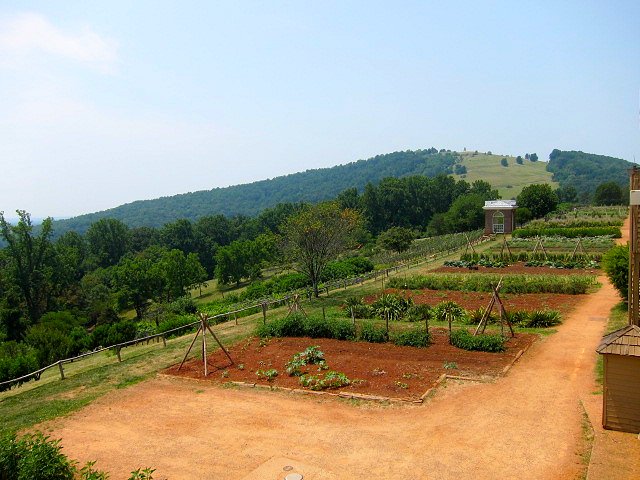
As readers of this blog will learn over time, I am partial to the decorative arts of England, America, and France during the late 18th and early 19th centuries.  Not only do I enjoy collecting and using items from this period for my home, whenever the opportunity arises and when funds permit, I also enjoy sourcing heirloom plants, both ornamental and useful, to add to my garden.  To that effect, it was with great pleasure that I had the opportunity to visit one of America's premier antique vegetable gardens, perched high upon the side of a mountain in Charlottesville, Virginia, and created by Thomas Jefferson at his home, Monticello. Jefferson, America's third president and the principal author of the Declaration of Independence, was an accomplished tobacco and grain farmer and a grower of fruits and vegetables.  Through constant experimentation, and at the garden's most productive period around 1812, the one-thousand foot-long terraced plot was used to grow at least 330 varieties of vegetables, most of which were used to feed family and visitors at Monticello.

Chronica Domus
High summer in the vegetable gardens of Monticello, photographed during my visit in 2012
Photo: Chronica Domus

On May 6, 1795 the sage of Monticello wrote in his journal "The first lettuce comes to the table". Well, I am pleased as punch to report that exactly 219 years later, give a day or two, my first Jeffersonian lettuce has arrived at my own table.  You see, when I visited the garden two summers ago, I came away with a souvenir; two packets of heirloom seeds harvested by those that tend Monticello's garden today.  I selected the seeds based on the fact that the varieties were grown on site in Jefferson's lifetime, not easily found elsewhere for purchase, and that frankly, I was unaware of the existence of the curious sounding Spotted Aleppo lettuce.  I was very keen to take a little bit of Monticello back with me to California, a place virtually unknown to Jefferson, in an attempt to cultivate the very same lettuce he grew all those years ago in Virginia.  Perhaps, if successful, I could even go as far as recreating a salad that would have been made in the kitchens of his home, and served to Jefferson, his family, and his guests.  Would such a salad taste and look differently than if I used modern varieties of lettuces available today?  I was curious and excited to make the discovery for myself.

Chronica Domus
An attractive seed packet of Lactuca sativa 'Spotted Aleppo' lettuce seeds harvested from plants grown at Monticello
Photo: Chronica Domus


This is the second season since purchasing my seeds that I have planted Spotted Aleppo, an 18th century variety regularly grown at Monticello and first procured in 1804 from Bernard McMahon, a prominent Philadelphia seedsman and mentor to Thomas Jefferson.  I was so enamored by the initial crop last year, and found it easy to cultivate, that I let the plants go to seed so as to enable me to collect more than enough for this year's sowing.  It was recorded that lettuce was planted an average of eight times annually at Monticello during the years 1809 through 1824.  Obviously, salads played a prominent role in Jefferson's diet.

Chronica Domus
A head of Spotted Aleppo lettuce exhibiting the characteristic rusty brown spots
Photo: Chronica Domus


I sowed my seeds on St. Patrick's day, March 17, in neat little rows in my Lilliputian vegetable garden. It took about a week until the cotyledons, the first sign of germination, pushed through the cool black earth. Those tiny leaves are always such an exciting time for any gardener to spot, full of hope and optimism for a bountiful crop. On May 9, with less than six weeks in the ground, I harvested enough tender leaves to make my salad, picked in the early morning sunshine, just as they were at Monticello, then laid in cool water and removed hours before they were needed at dinner. At maturity I discovered the Spotted Aleppo, a type of romaine lettuce, is far more diminutive in scale than the hefty romaine we know today.  I estimate that the length of the leaves are no more than about eight inches.  They are also much more tender and delicate, and not at all tough and crunchy.

Chronica Domus
More of Jefferson's speckled lettuces basking in the sunshine of my vegetable garden
Photo: Chronica Domus


Esculent nasturtium flowers, that grow with abandon in my garden, were added to the lettuce leaves so that I could accurately recreate a salad that would have been a familiar sight at the dining tables of Monticello. Not only were these cheery flowers used to prepare salads by Jefferson's cooks, the leaves too were mixed in with other greens and lettuces. Nasturtium seeds were also utilized surprisingly, so nothing went to waste. These were a substitute for capers so I would imagine they were somehow pickled to serve their purpose. An 1,800 square foot bed was dedicated to the growth of nasturtiums at Monticello, planted annually between 1812 and 1824.

Chronica Domus
My garden trug holding freshly picked lettuce leaves and nasturtium flowers ready to be taken into the house
Photo: Chronica Domus


Jefferson's travels to Europe helped hone his interest in French cuisine and opened new gastronomical worlds for him.  He would send back foodstuffs, such as wine vinegar and virgin olive oil from France, to be used in the preparation of salads and vegetables.  As much as he enjoyed expensive imported olive oil, he did note that the freshness was somewhat compromised through its exposure to hot storage environments as it made its passage across the Atlantic ocean and to his home.  With this in mind, he experimented with growing sesame plants to produce a domestic salad oil that would provide a possible substitute for his favored olive oil, having once described it as "the richest gift of heaven".  Of sesame oil he said, "I did not believe there existed so perfect a substitute for olive oil".  Try as he might, he could not produce a worthwhile quantity of oil from his sesame plants despite seven years of persistence.

Salads at Monticello would be dressed at table with the oil and vinegar having been stored in glass cruets.  In my recreation of the salad, I substituted Spanish wine vinegar for tarragon vinegar, which was often used at Monticello, and introduced freshly cut French tarragon, Thomas Jefferson's favorite herb, into the mix of lettuces and nasturtium flowers.  With the final addition of a sprinkling of coarse salt, and a crack or two of the pepper mill, my home grown Jeffersonian salad was complete.

Chronica Domus
Late 18th century glass cruet bottles containing extra virgin olive oil and wine vinegar to dress the salad.  Jefferson used similar bottles but his were designed with a silver lip and handle.
Photo: Chronica Domus


Chronica Domus
An antique salad recognizable to Thomas Jefferson had he been a guest at my table
Photo: Chronica Domus


Dinner was served much earlier in Jefferson's day and to honor that tradition my salad was eaten around 4 p.m., the time the second bell rang to alert guests that they should assemble in the dining room to begin their meal at Monticello.

Chronica Domus
All done, and how delicious that was!
Photo: Chronica Domus


As I sampled the tender spotted leaves, the peppery bright flowers, and the pungent French tarragon, I toasted Jefferson and thanked him for his inspiration that I might eat as well as he, on simple food that had been grown in my own garden, with seeds from his. It was, indeed, a most satisfactory feeling.  To these simple ingredients, the addition of imported olive oil and vinegar that is now shipped to my home in a matter of days rather than weeks, as was the case in Jefferson's day, completed my salad, an edible antique and one that would be wholly recognizable to him were he to have joined me at my humble table.  I can only imagine the conversation that would ensue.  Would we wax lyrical about the quality, variety, and sheer quantity of food available to us in 21st century America?  Would he be surprised and pleased to discover how much of that food was locally grown and produced in California, including his favorite salad oil? And, what would he think of food globally produced, much of it perishable, and flown magically through the skies to reach our plates in peak condition?  Would we also deliberate, in shared disappointment, the modern norm of so few meals being taken while actually seated at a dining table?

Growing your own antique salad can successfully be accomplished in a small corner of the garden or through the use of several large containers.  Fortunately, one need no longer make the pilgrimage to Monticello to lay hands on these heirloom jewels, thanks to the modern wonders of internet shopping.  I urge you to try these surprisingly tasty old varieties for you too will discover their ease of growth and their deliciousness.

Our eating habits may have changed over the past two centuries but one thing that will always remain the same is our tendency towards Jefferson's famed "pursuit of happiness". For those much like myself, this will always include good friends, lively conversation, a shared bottle of wine, and wonderfully simple meals boasting of the earth's bounty.


Nota bene: I am neither paid nor do I receive recompense in exchange for applauding products or services within my blog.  I do so because I enjoy them.  If you are a kindred spirit, you too enjoy recommending nice things to fellow good eggs.

Saturday, May 3, 2014

Revisiting An Old Friend In The Garden

Chronica Domus
 Finally, a way through to the peony 
Photo: Chronica Domus


I've been a naughty gardener and neglectful of my poor old white tree peony.  In the mad growth of the pink rose bushes, (unfortunately, the name escapes me), I've let them clamber and swallow up what was once a show stopper of a plant.  Just last weekend, I was wondering what on earth had happened to the peony.  It blooms magnificently and faithfully at this time of year, but not so this spring, or last come to think of it. Secateurs to the ready, I began the process of carefully snipping and cutting away at the roses until I found the thing. Poor old peony.  It was still there but barely, and gasping for breath.  I was shocked at its feeble size, reduced to a thin stick, with a few young leaves to crown it. One of the main woody stems had been dragged to the ground and pinned there by the ferocious ivy growing up the fence and now creeping along the ground.  It had done a cunningly murderous job of enveloping and suffocating the peony.  The evil ivy had to go, there was no doubt about it! Three hours later, having given the matter my rapt attention, I had barely made a dent grappling with the rope-like runners that had not only destroyed the peony but had also bound itself slyly around the base of the roses.  To add insult to injury, somehow an established blackberry cane had entangled itself into the mess.

Can you spot the pitiful peony?  
Photo: Chronica Domus


It was not all bad news in that lively corner of the garden.  An old friend was there too to keep me company in the form of a Japanese honeysuckle vine. I was given the creamy yellow honeysuckle as a gift from my dear friend John.

Chronica Domus
The first blossom on the Japanese jasmine
Photo: Chronica Domus


John was that rare breed of being that one may encounter in life if fortunate.  He was erudite, witty, creative, well-mannered, great fun and humble.  In short, an enchanting combination.  John did not have a garden but kept his small ground floor apartment's patio lush with containers bursting with healthy plant life.  It was a little oasis out there with something of interest in bloom throughout the year. John grew the honeysuckle in a trough but knew it would not thrive in such confined conditions. He generously gave it to me to see how well it would do in my garden.   I was not to know it at the time, but within a few short years of this gift, John was to shockingly die in a tragic accident. Each spring I am reminded of my dear friend as I catch the sweet fragrance wafting  from the blooms and carried by the gentle breezes.  I savored the first bloom of the year as I was at war with the ivy and it pleased me no end. The delicious smell was incredibly evocative and I was instantly reminded of the wonderful times my husband and I spent in John's cosmopolitan company sipping wine on his patio and partaking of his wonderful cooking.  Our fun and spirited discussions would often cross into the early hours of the morning.  I remember too a party John and I threw at my home for a mutual friend and his wife who were about to depart the country for a long-term job assignment in India.  John and I planned every detail; the food, the wines, the flowers, the guest list.  He promised to return the morning following the party to help put the house back together and deal with the aftermath.  Instead, looking not a little worse for wear and nursing the remnants of a lingering hangover, he appeared at my doorstep sporting his trademark wry smile, at noon.  After downing some strong coffee, we picked up exactly where we left off the evening prior and ended up relaxing on the sunny balcony, taking in the view, drinking the remainder of the chilled white wine and nibbling on leftovers, chatting and laughing as we relived the great success of the previous evening's festivities. Needless to say, I was left to clean up on my own after John departed for his home much later in the afternoon. What did I expect?  He was always so useless before noon and his first cup of coffee.

Chronica Domus
My friend John thriving in the garden
Photo: Chronica Domus


These honeyed memories of our friend John are what make the rambling honeysuckle my most sentimental and cherished plant.  It will uniquely insure his memory remains warmly with me for as long as it thrives and spreads in my little garden.  It has now been a dozen years since this jasmine left John's life and entered mine, and ten since his life ended.  As Voltaire wrote in the closing of his story Candide, "Let us cultivate our garden".  I take his words to be a metaphor for thoughtfully choosing to add elements of value to one's life and for pulling up the "weeds" which may sap one's strength and spirit.

Do you have an especially meaningful plant growing in your home or garden?  If not, consider sharing some seeds, a cutting, or even a small shrub or plant with your nearest and dearest friends and family members. The long-term rewards may surprise both you and the fortunate recipient for many years to come.
Related Posts Plugin for WordPress, Blogger...