Wednesday, May 14, 2014

An Edible Antique: Recreating A Jeffersonian Salad

Chronica Domus
A home grown Jeffersonian salad comprised of Spotted Aleppo lettuce, nasturtium flowers and French tarragon
Photo: Chronica Domus


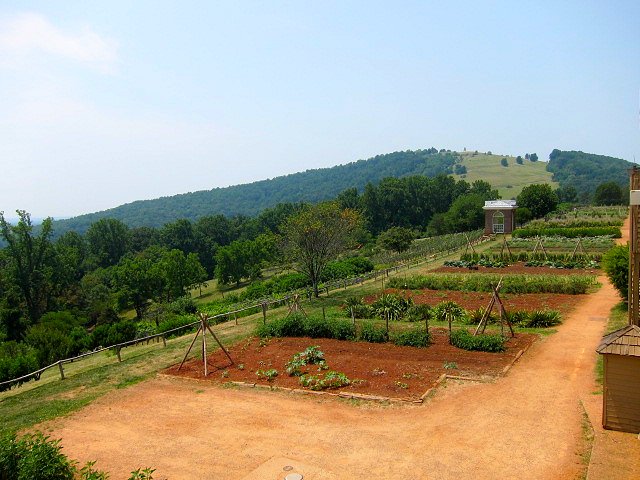
As readers of this blog will learn over time, I am partial to the decorative arts of England, America, and France during the late 18th and early 19th centuries.  Not only do I enjoy collecting and using items from this period for my home, whenever the opportunity arises and when funds permit, I also enjoy sourcing heirloom plants, both ornamental and useful, to add to my garden.  To that effect, it was with great pleasure that I had the opportunity to visit one of America's premier antique vegetable gardens, perched high upon the side of a mountain in Charlottesville, Virginia, and created by Thomas Jefferson at his home, Monticello. Jefferson, America's third president and the principal author of the Declaration of Independence, was an accomplished tobacco and grain farmer and a grower of fruits and vegetables.  Through constant experimentation, and at the garden's most productive period around 1812, the one-thousand foot-long terraced plot was used to grow at least 330 varieties of vegetables, most of which were used to feed family and visitors at Monticello.
Chronica Domus
High summer in the vegetable gardens of Monticello, photographed during my visit in 2012
Photo: Chronica Domus

On May 6, 1795 the sage of Monticello wrote in his journal "The first lettuce comes to the table". Well, I am pleased as punch to report that exactly 219 years later, give a day or two, my first Jeffersonian lettuce has arrived at my own table.  You see, when I visited the garden two summers ago, I came away with a souvenir; two packets of heirloom seeds harvested by those that tend Monticello's garden today.  I selected the seeds based on the fact that the varieties were grown on site in Jefferson's lifetime, not easily found elsewhere for purchase, and that frankly, I was unaware of the existence of the curious sounding Spotted Aleppo lettuce.  I was very keen to take a little bit of Monticello back with me to California, a place virtually unknown to Jefferson, in an attempt to cultivate the very same lettuce he grew all those years ago in Virginia.  Perhaps, if successful, I could even go as far as recreating a salad that would have been made in the kitchens of his home, and served to Jefferson, his family, and his guests.  Would such a salad taste and look differently than if I used modern varieties of lettuces available today?  I was curious and excited to make the discovery for myself.

Chronica Domus
An attractive seed packet of Lactuca sativa 'Spotted Aleppo' lettuce seeds harvested from plants grown at Monticello
Photo: Chronica Domus


This is the second season since purchasing my seeds that I have planted Spotted Aleppo, an 18th century variety regularly grown at Monticello and first procured in 1804 from Bernard McMahon, a prominent Philadelphia seedsman and mentor to Thomas Jefferson.  I was so enamored by the initial crop last year, and found it easy to cultivate, that I let the plants go to seed so as to enable me to collect more than enough for this year's sowing.  It was recorded that lettuce was planted an average of eight times annually at Monticello during the years 1809 through 1824.  Obviously, salads played a prominent role in Jefferson's diet.

Chronica Domus
A head of Spotted Aleppo lettuce exhibiting the characteristic rusty brown spots
Photo: Chronica Domus


I sowed my seeds on St. Patrick's day, March 17, in neat little rows in my Lilliputian vegetable garden. It took about a week until the cotyledons, the first sign of germination, pushed through the cool black earth. Those tiny leaves are always such an exciting time for any gardener to spot, full of hope and optimism for a bountiful crop. On May 9, with less than six weeks in the ground, I harvested enough tender leaves to make my salad, picked in the early morning sunshine, just as they were at Monticello, then laid in cool water and removed hours before they were needed at dinner. At maturity I discovered the Spotted Aleppo, a type of romaine lettuce, is far more diminutive in scale than the hefty romaine we know today.  I estimate that the length of the leaves are no more than about eight inches.  They are also much more tender and delicate, and not at all tough and crunchy.

Chronica Domus
More of Jefferson's speckled lettuces basking in the sunshine of my vegetable garden
Photo: Chronica Domus


Esculent nasturtium flowers, that grow with abandon in my garden, were added to the lettuce leaves so that I could accurately recreate a salad that would have been a familiar sight at the dining tables of Monticello. Not only were these cheery flowers used to prepare salads by Jefferson's cooks, the leaves too were mixed in with other greens and lettuces. Nasturtium seeds were also utilized surprisingly, so nothing went to waste. These were a substitute for capers so I would imagine they were somehow pickled to serve their purpose. An 1,800 square foot bed was dedicated to the growth of nasturtiums at Monticello, planted annually between 1812 and 1824.

Chronica Domus
My garden trug holding freshly picked lettuce leaves and nasturtium flowers ready to be taken into the house
Photo: Chronica Domus


Jefferson's travels to Europe helped hone his interest in French cuisine and opened new gastronomical worlds for him.  He would send back foodstuffs, such as wine vinegar and virgin olive oil from France, to be used in the preparation of salads and vegetables.  As much as he enjoyed expensive imported olive oil, he did note that the freshness was somewhat compromised through its exposure to hot storage environments as it made its passage across the Atlantic ocean and to his home.  With this in mind, he experimented with growing sesame plants to produce a domestic salad oil that would provide a possible substitute for his favored olive oil, having once described it as "the richest gift of heaven".  Of sesame oil he said, "I did not believe there existed so perfect a substitute for olive oil".  Try as he might, he could not produce a worthwhile quantity of oil from his sesame plants despite seven years of persistence.

Salads at Monticello would be dressed at table with the oil and vinegar having been stored in glass cruets.  In my recreation of the salad, I substituted Spanish wine vinegar for tarragon vinegar, which was often used at Monticello, and introduced freshly cut French tarragon, Thomas Jefferson's favorite herb, into the mix of lettuces and nasturtium flowers.  With the final addition of a sprinkling of coarse salt, and a crack or two of the pepper mill, my home grown Jeffersonian salad was complete.

Chronica Domus
Late 18th century glass cruet bottles containing extra virgin olive oil and wine vinegar to dress the salad.  Jefferson used similar bottles but his were designed with a silver lip and handle.
Photo: Chronica Domus


Chronica Domus
An antique salad recognizable to Thomas Jefferson had he been a guest at my table
Photo: Chronica Domus


Dinner was served much earlier in Jefferson's day and to honor that tradition my salad was eaten around 4 p.m., the time the second bell rang to alert guests that they should assemble in the dining room to begin their meal at Monticello.

Chronica Domus
All done, and how delicious that was!
Photo: Chronica Domus


As I sampled the tender spotted leaves, the peppery bright flowers, and the pungent French tarragon, I toasted Jefferson and thanked him for his inspiration that I might eat as well as he, on simple food that had been grown in my own garden, with seeds from his. It was, indeed, a most satisfactory feeling.  To these simple ingredients, the addition of imported olive oil and vinegar that is now shipped to my home in a matter of days rather than weeks, as was the case in Jefferson's day, completed my salad, an edible antique and one that would be wholly recognizable to him were he to have joined me at my humble table.  I can only imagine the conversation that would ensue.  Would we wax lyrical about the quality, variety, and sheer quantity of food available to us in 21st century America?  Would he be surprised and pleased to discover how much of that food was locally grown and produced in California, including his favorite salad oil? And, what would he think of food globally produced, much of it perishable, and flown magically through the skies to reach our plates in peak condition?  Would we also deliberate, in shared disappointment, the modern norm of so few meals being taken while actually seated at a dining table?

Growing your own antique salad can successfully be accomplished in a small corner of the garden or through the use of several large containers.  Fortunately, one need no longer make the pilgrimage to Monticello to lay hands on these heirloom jewels, thanks to the modern wonders of internet shopping.  I urge you to try these surprisingly tasty old varieties for you too will discover their ease of growth and their deliciousness.

Our eating habits may have changed over the past two centuries but one thing that will always remain the same is our tendency towards Jefferson's famed "pursuit of happiness". For those much like myself, this will always include good friends, lively conversation, a shared bottle of wine, and wonderfully simple meals boasting of the earth's bounty.


Nota bene: I am neither paid nor do I receive recompense in exchange for applauding products or services within my blog.  I do so because I enjoy them.  If you are a kindred spirit, you too enjoy recommending nice things to fellow good eggs.

Saturday, May 3, 2014

Revisiting An Old Friend In The Garden

Chronica Domus
 Finally, a way through to the peony 
Photo: Chronica Domus


I've been a naughty gardener and neglectful of my poor old white tree peony.  In the mad growth of the pink rose bushes, (unfortunately, the name escapes me), I've let them clamber and swallow up what was once a show stopper of a plant.  Just last weekend, I was wondering what on earth had happened to the peony.  It blooms magnificently and faithfully at this time of year, but not so this spring, or last come to think of it. Secateurs to the ready, I began the process of carefully snipping and cutting away at the roses until I found the thing. Poor old peony.  It was still there but barely, and gasping for breath.  I was shocked at its feeble size, reduced to a thin stick, with a few young leaves to crown it. One of the main woody stems had been dragged to the ground and pinned there by the ferocious ivy growing up the fence and now creeping along the ground.  It had done a cunningly murderous job of enveloping and suffocating the peony.  The evil ivy had to go, there was no doubt about it! Three hours later, having given the matter my rapt attention, I had barely made a dent grappling with the rope-like runners that had not only destroyed the peony but had also bound itself slyly around the base of the roses.  To add insult to injury, somehow an established blackberry cane had entangled itself into the mess.

Can you spot the pitiful peony?  
Photo: Chronica Domus


It was not all bad news in that lively corner of the garden.  An old friend was there too to keep me company in the form of a Japanese honeysuckle vine. I was given the creamy yellow honeysuckle as a gift from my dear friend John.

Chronica Domus
The first blossom on the Japanese jasmine
Photo: Chronica Domus


John was that rare breed of being that one may encounter in life if fortunate.  He was erudite, witty, creative, well-mannered, great fun and humble.  In short, an enchanting combination.  John did not have a garden but kept his small ground floor apartment's patio lush with containers bursting with healthy plant life.  It was a little oasis out there with something of interest in bloom throughout the year. John grew the honeysuckle in a trough but knew it would not thrive in such confined conditions. He generously gave it to me to see how well it would do in my garden.   I was not to know it at the time, but within a few short years of this gift, John was to shockingly die in a tragic accident. Each spring I am reminded of my dear friend as I catch the sweet fragrance wafting  from the blooms and carried by the gentle breezes.  I savored the first bloom of the year as I was at war with the ivy and it pleased me no end. The delicious smell was incredibly evocative and I was instantly reminded of the wonderful times my husband and I spent in John's cosmopolitan company sipping wine on his patio and partaking of his wonderful cooking.  Our fun and spirited discussions would often cross into the early hours of the morning.  I remember too a party John and I threw at my home for a mutual friend and his wife who were about to depart the country for a long-term job assignment in India.  John and I planned every detail; the food, the wines, the flowers, the guest list.  He promised to return the morning following the party to help put the house back together and deal with the aftermath.  Instead, looking not a little worse for wear and nursing the remnants of a lingering hangover, he appeared at my doorstep sporting his trademark wry smile, at noon.  After downing some strong coffee, we picked up exactly where we left off the evening prior and ended up relaxing on the sunny balcony, taking in the view, drinking the remainder of the chilled white wine and nibbling on leftovers, chatting and laughing as we relived the great success of the previous evening's festivities. Needless to say, I was left to clean up on my own after John departed for his home much later in the afternoon. What did I expect?  He was always so useless before noon and his first cup of coffee.

Chronica Domus
My friend John thriving in the garden
Photo: Chronica Domus


These honeyed memories of our friend John are what make the rambling honeysuckle my most sentimental and cherished plant.  It will uniquely insure his memory remains warmly with me for as long as it thrives and spreads in my little garden.  It has now been a dozen years since this jasmine left John's life and entered mine, and ten since his life ended.  As Voltaire wrote in the closing of his story Candide, "Let us cultivate our garden".  I take his words to be a metaphor for thoughtfully choosing to add elements of value to one's life and for pulling up the "weeds" which may sap one's strength and spirit.

Do you have an especially meaningful plant growing in your home or garden?  If not, consider sharing some seeds, a cutting, or even a small shrub or plant with your nearest and dearest friends and family members. The long-term rewards may surprise both you and the fortunate recipient for many years to come.

Saturday, April 26, 2014

The Annual Marmalade Making Adventure Continues

It felt like Christmas in April as I opened Reggie's beautifully wrapped kumquat marmie as part of The Great Marmalade Exchange of 2014
Photo: Chronica Domus


Back in February I posted a piece, that can be read here, on how we, or more specifically my husband, came to make marmalade at home, something that has now evolved into an annual rite of winter.  The first comment I received on the story was from Reggie Darling, the author of the wildly popular Reggie Darling, The View From Darlington House (I'm sure there aren't too many readers left in this corner of the blogosphere who've yet to discover this elegantly stylish, informative, and witty blog).  After a few emails transpired between us, the idea of The Great Marmalade Exchange was hatched.  You can read all about it at Reggie's blog here.

Reggie's preferred way of eating marmie, straight off the spoon!
Photo: Chronica Domus


Who knew that when we began our Annual Marmalade Making Adventure and I wrote about it, it would add impetus to the marmalade making aspirations of one of my favorite bloggers.  This week, I happily received a jar of Reggie's kumquat marmie, beautifully wrapped in blousy tissue paper and ribbon, and nesting in a bed of excelsior.  I can report firsthand that his inaugural effort into marmalade pursuits has resulted in the perfect storm in a jar; a confluence of juice, rind, and sugar making for a puckery spread which is absolutely delish!  Bravo Reggie!  My family and I enjoyed the marmie this morning at breakfast on our buttered toast with cups of tea.  We got through nearly half the jar before my insistence that it be put away so we could all enjoy it again on another morning. It was that good!

I am aware that marmalade is not as popular as other preserves at breakfast time in this country, but could that have come about as a result of having tasted only commercially available cloying concoctions?  Traditionally, homemade marmalade is an entirely different animal; less sweet, more bitter and therefore much more likely to make an impression upon the palate.  Some will never come to love marmalade, but an informed opinion is simply not possible without first having tried a properly bitter batch made fresh at home.  Into which camp do you fall - love it, or loathe it?

Saturday, April 19, 2014

Paschal Pleasures: The Egg

Chronica Domus
Eggs in hues of pale green, buff and pale blue
Photo: Chronica Domus


Each year as we prepare to celebrate Easter, eggs are the recurring central theme in the decoration of our home. Whereas many households focus their seasonal imagery around lambs, bunnies and chicks, for us it is all about the egg.  We don't over do it when it comes to decorating, instead choosing to add a vase of flowering seasonal branches, a compote or two of eggs that have been dyed by my daughter, as well as a variety of Easter chocolate confections.

I was given some rather unusual eggs by my sister-in-law that I thought would be an eggcelent excellent addition to the annual Easter egg hunt that my daughter so enjoys.  Here they are in my garden trug awaiting their clandestine spot in the flower bed.

Chronica Domus
Rhea, emu, goose and partridge eggs beneath the flowering Polygonatum
Photo: Chronica Domus


The eggs vary in size from the smallest two inch drab colored partridge example to the largest six inch rhea giants in the most delicate lemon chiffon color.  The darkest egg was produced by an emu and has a granulated surface in deep teal and is about five inches in length.  A pure white three inch goose egg is also in the mix.

Chronica Domus
The hidden eggs awaiting discovery by my daughter
Photo: Chronica Domus


These were fun to tuck in among the spring flowers and they blended in rather well with their naturally colored shells.  I hid the emu egg in a little mound of violas.

Chronica Domus
An Emu egg in disguise
Photo: Chronica Domus


The partridge egg's drab olive tone worked well hidden in the violet patch.  I'm just hoping the resident Scrub Jays don't get to it before my daughter does.  Many years ago, I had displayed a basket of dyed eggs on my kitchen table close to a partially opened window.  To my astonishment a Scrub Jay flew into the kitchen and claimed his bounty by pecking the eggs to pieces.  It was truly a remarkable moment of nature gone bad, but why was I surprised by this?  They are, after all, nest robbers by vocation.

Chronica Domus
Could you have found the partridge egg as is blends effortlessly into the violet patch?
Photo: Chronica Domus


The giant rhea and smaller goose eggs were a little less difficult to find due to their bright shells and large size.

Chronica Domus
Not so much hiding but looking pretty in the spring garden
Photo: Chronica Domus


These naturally hued jewels are such a fun twist on the traditional Easter egg hunt that I think I'll do it all again next year.  I'm sure both adults and children alike would enjoy hunting for these whimsical beauties.

I wish you all a very Happy Easter.

Saturday, April 12, 2014

Auction Day


The bough (or cache) pot of my dreams: A John Turner black basalt pot with lid (circa 1780 to 1806), as seen in an article written by the ceramics expert Mrs. Willoughby Hodgson, author of How To Identify Old China


As I left off in in my previous post, which can be read here, I could hardly stand the wait until the commencement of the auction the following day.  The small distraction of having my daughter's friend stay the night helped pass the time a little more swiftly, as I was charged with whipping up a Sunday breakfast to impress two ravenously hungry young  ladies. Freshly baked popovers with lashings of creamy butter and a dollop of raspberry jam, scrambled eggs, ripe strawberries and, as if I needed the stimulating effects of caffeine, a personal pot of strong coffee to fortify me through the lunch hour.

The auction is to begin at 10 a.m. sharp, and as the lot I am interested in will not come under the hammer until later in the day, we leave the house in the early afternoon to make our way to the sale.  Upon arrival, plenty of time remains to register at the desk, collect our paddle, and watch as several lots sell. My husband and I take the opportunity to assess the collection of ceramics on offer in the event I have missed anything of interest from the prior day in my excitement.  There are certainly some tempting pieces; the urn shaped vases and incense burner speak to me in particular.  If we are to hold hope for a successful bid on our lot of interest, we will have to remain focused on the prize and keep our powder dry.

I'm sure by now you are wondering what exactly it is that has tingled my spine and induced me into such an excitable state.  I should note that although my holy grail of the basalt world is not something which would necessarily appeal to everyone, for me the piece encompasses both my passion for flowers as well as for  containers to arrange them. I am drawn to the severe urn-like form of this piece (I have a "thing" for urns), its neoclassical cartouche decorations, its plinth, ball and paw feet, as well as to the item's intended purpose. In fact, it is something I have long coveted since it arrived at my notice, by way of an old photograph, contained within a book on ceramics (illustrated above).  I have never seen one of these pieces in the flesh prior to my nail biting day at auction.

So, here I am, with not just one of these long sought after items, but two.  Yes, TWO, and they are both offered within the same lot.  Can the necessary variables withstand such luck, namely my husband, my nerves, and my bank account?

Chronica Domus
The lot that led to my undoing
Photo: Chronica Domus


For many years, I have hoped to stumble across one of these illusive beauties, and introduce it to my little collection of black basalt. Outside of the pair photographed above, I have never actually seen one for sale. While researching this piece, I discovered such a pair had sold at auction in London many years prior, but  were notably missing their perforated lids.  In this instance both the pyramidal surmounted lids are included and intact.  There is not a chip, scratch or repair between the four pieces.  They are perfect in every possible way, and I want them!

These bough pots (or cache pots as they are sometimes called), were made by John Turner, the master potter, friend and rival of Josiah Wedgwood, sometime between 1780 and 1806. Interestingly, many of Turner's designs unabashedly reflected the influence of Wedgwood. Look at the following photograph I found in my copy of the auction catalog from the Milton Milestone Wedgwood sales held in New York in 1975 and 1976. Clearly, the Wedgwood pots and the Turner pots could have been made by the same hand.  Don't you agree?

A pair of Wedgwood bough pots in the collection of Milton Milestone that was sold at Sotheby's on April 6, 1976 in New York
Photograph: Chronica Domus

As the ceramic lots begin arriving on the block, the auction room is about half full.  I have speculated in the run up as to who, if anyone, should be my rival when pursuing my quarry. My husband and I are seated toward the middle of the room which places the majority of bidders behind us.  We really cannot get a good grasp on the competition.  After much dithering, we decide to move towards the back of the room which, to our way of thinking, affords a better vantage point on the proceedings.

The black basalt tea ware lots are selling fast, one after the other.  Most sell within the estimated range, which I take as strong indication that I may be in with a chance when it comes my turn to bid. The bough pots are rapidly approaching and I can feel my heart pounding harder and harder.

I've been in this room many times prior to today and have often been the successful bidder on items that are now resting proudly in my home.  However, on this occasion, seeing the interest intensify as my lot approaches the auction block, wracked with nerves I turn to jelly. I am suddenly a feeble wobbly mess and stand little chance of surviving the battle ahead. There is only one thing to do.  I turn the paddle over to my trusty husband, my rock, and take my chances.  And, what a good job he did!  The two bidders in the room, one a dealer who had already successfully won many items of furniture and decoration, the other a collector, have rapidly run up the price. Then, out of the blue, a live internet bidder chimes in to raise the heat.  My husband is next.  I can barely look as the auctioneer announces "we have a new bidder in the back".  It is now a war between the internet bidder and us.  After several bidding rounds, my husband looks at me and says "should I?", meaning shall we bid to win.  "Yes do", I nervously mutter, trepidation etched on my face, barely getting the words out of my parched mouth, and praying this will not lead to ruin as the pace and price escalate in tandem. I begin to breathe again just in time to see the auctioneer motion towards my husband to show her his paddle. Victory! We've won!  I can barely comprehend it. I need to sit down and compose myself.  I really should have packed my smelling salts as I have transformed into a complete nervous Nellie.   Although I am not a serious collector of ceramics, at least by most people's definition, I feel as though we were pitted against a few of them at this auction.

Chronica domus
Our bough pots looking pretty with their spring blooms
Photo: Chronica Domus


I am ecstatic that we are now the proud stewards of these two beautiful vessels that will be very well appreciated and used for their intended purpose.  In fact, just this morning, I raced out of the house to purchase some spring blooms at the farmers' market.  It was so much fun to arrange the flowers within the pyramidal lids.  Each has a dozen holes, three per side, and act much like a flower frog. When not in use, they shall have pride of place on one of our side tables or atop the mantel.  I cannot help but wonder where the veiled caryatids at each of the four corners of the pots have lived in their two hundred years of existence, how they've traveled across the seas from England and their humble beginnings in Staffordshire, and how their prior owners used and displayed them.  This evening, these two beauties will grace our dining table, where they shall punctuate our lily white tablecloth with their dark and stately presence.  Admittedly, these were a bit of a splurge for us, but the color has finally been restored to my husband's face and all is well as I await the next great find.

Sunday, April 6, 2014

An Auction Preview To Excite


Chronica Domus
A substantial (and tempting) late 18th century black basalt urn shaped vase and cover by Wedgwood & Bentley
Photo: Chronica Domus


This past February, I attended an auction where, unfortunately, I was the unsuccessful bidder on a piece of artwork. While there, I spotted a few items of interest that were not part of the current sale.  They were prominently displayed in the two glass cases flanking the entrance doors to the auction house. I inquired at the registration desk as to when the two Wedgwood urns and the black basalt sphinx candlestick would be coming under the hammer.  I was told these items were to be featured in the next Period Art and Design sale at the end of March. Unfortunately, the catalog for that auction was not yet available for viewing.  All I could do was wait another month to see what else might catch my eye.

Chronica Domus
A pair of 19th century Wedgwood jasper urns in an unusual straw color with black decoration.
Photo: Chronica Domus


When the catalog was eventually made available for viewing in mid-March, I found myself being simultaneously overjoyed and heart poundingly nervous at the sight of a substantial haul of ceramic goodies on offer. Part of the overall sale featured a large collection of late eighteenth and early nineteenth century black basalt pieces manufactured by Wedgwood and his contemporaries, a particular collecting interest of mine.  There were also many pieces of jasperware in an assortment of colors and color combinations, caneware, and several impressive porphyry glazed terracotta pieces.  I knew this auction could steer me into imminent danger and lead to my undoing upon spying lot after lot of items I'd only ever seen between the walls of a museum or the covers of reference books.  This was by far the largest collection of  early Wedgwood I had ever seen outside of the official Wedgwood museum in Stoke-on-Trent.  Of course other large collections have come up for sale in other well respected auction houses within the United States, but I can tell you that I live on the wrong side of the country for such things to appear locally.  This was definitely an auction to induce an experience worthy of smelling salts.


Chronica Domus
A diminutive black basalt urn shaped vase and cover
Photo: Chronica Domus


With this in mind, what was a girl to do when confronted with a veritable chocolate box of goodies?  Well, the answer, of course, would be to attend the auction's preview, and that is exactly what I did last Saturday. My good friend and neighbor, who is often my partner in crime on such hunts, accompanied me on this expedition and was my voice of reason as we both ogled the cases bursting with pretties.

The preview rooms were hopping with interested individuals and potential bidders scouring both the decorative arts pieces on offer, and the trove of fine jewelry that was to be featured as part of the Salon Jewelry Sale on the day following the Period Art and Design Sale.

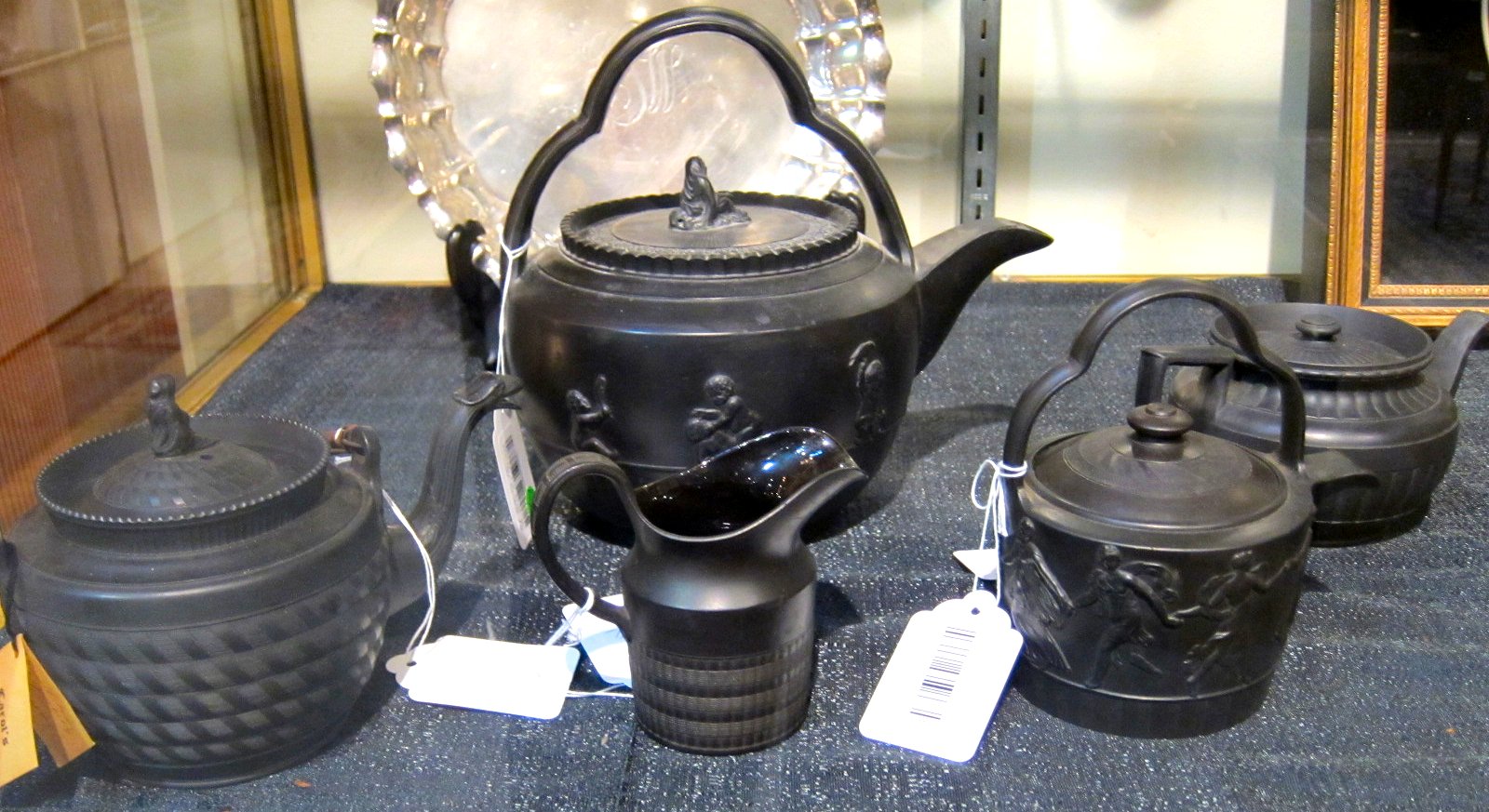
The collection I had come to view was divided into forty-three lots.  Of those, seventeen comprised exclusively of black basalt pieces. There was an abundance of tea and coffee pots, sugar bowls, creamers and milk jugs decorated in a variety of engine turned designs and applied relief molding.

Chronica Domus
A lot of tea ware including a tea canister (back right), and a teapot with a swan finial manufactured by William Baddeley of Eastwood
Photo: Chronica Domus


Chronica Domus
This lot of tea ware included a teapot manufactured by the Spode factory (back right)
Photo: Chronica Domus


Chronica Domus
Yet another lot of tea ware comprised mainly of engine turned designs
Photo: Chronica Domus

Several urns were featured in various sizes along with incense burners, spittoons, vases, a tea canister and even a large punch pot.  Oh, and the lone sphinx candlestick I had seen back in February was now featured as a lot on its own.

Chronica Domus
A beautiful late 18th century Wedgwood & Bentley black basalt urn shaped vase with lid, a very tempting piece
Photo: Chronica Domus


All of  the pieces I examined appeared to be in excellent condition with barely a chip or scratch between them.  Obviously, whoever compiled the collection (and I would guess at least the basalt pieces came from a single collector), took great care of it and had exacting standards when adding to it.  Some of the pieces I handled came complete with previous auction tags marking their passage through prior sales.  I spotted a few from an auction that Sotheby's held in New York in 1984, and others from their earlier sales.  There were even lot tags from auctions held at Philips in London.  One sticker of note adhered to the underside of an urn had indicated its provenance through the collection of Milton Milestone, the renowned international collector of Wedgwood. Further research tells me it may have left the nest during one of two great sales held in 1975 and 1976 by Sotheby's in New York.

Chronica Domus
 A spittoon, urn shaped vase (formerly in the collection of Milton Milestone), and a sublime incense burner
Photo: Chronica Domus

Chronica Domus
An appetizing  lot comprised of a cylindrical vase (center), an urn shaped vase (right), and what I think to be the bottom of a cassolette (left, described as a vase)
Photo: Chronica Domus

Within the dizzying selection of lots, there were several examples of basalt to tempt me. However, those pieces were distributed over several lots and I was not interested in buying  lots in their entirety just to add a minority of included items to my own humble collection. Not to worry, as every item I'd seen, no matter how impressive it was initially, fell to the wayside once I'd spotted the one spectacular lot I knew I had to have. It was one of those visceral moments that set my heart aflutter and took my breath away, and it most assuredly qualified as a smelling salt moment.

I could hardly contain my excitement and nervousness and could tell that it would be an agonizing twenty-four hour wait until the opening of the auction the following day.  My poor dear husband, not hearing the end of it, would surely be feeling as though the time could not arrive soon enough.

Chronica Domus
A Wedgwood & Bentley porphyry glazed terracotta vase on a black basalt base with mask decorations at the base of the handles
Photo: Chronica Domus


Chronica Domus
An impressive pair of late 18th century Wedgwood porphyry glazed terracotta urns formerly in the Zeitlin ceramics collection
Photo: Chronica Domus


In my next post I will share what held me so spellbound and whether or not I was the successful bidder on what I considered to be the holy grail of black basalt pieces for my small personal collection.

I hope you'll join me on the auction floor for the conclusion of my story.


Wednesday, April 2, 2014

What Is (was) Blooming Inside

Spring blooming flowers arranged in a black basalt sugar basin
Photo: Chronica Domus


Nota bene: I had intended to publish this post back in February but it somehow got buried within the other posts I was working on.  I hope you enjoy it despite the fact that these little flowers are long gone and remain but a pleasant memory.

As you will learn over time on this blog, I love flowers and other natural elements that I am able to bring into my home to enjoy.  I feel that no matter how fine the contents, or how beautiful one's home is, it becomes even more so with the addition of seasonal gifts from the natural world.   Take, for example, the diminutive arrangement pictured in the preceding photograph.  I picked the last of the blue grape hyacinth stragglers and the sunny Avalanche narcissi that were blooming around my home (seen here), and added some cheery yellow and white tulips I had purchased at the San Francisco Flower Market.  The arrangement sits on our drawing room's mantel and brightens the room no end.  Don't you agree?

A close up view of the cheery arrangement on our mantel
Photo: Chronica Domus


Any surface or corner of your home will be enhanced greatly by any size arrangement, no matter how small or large,  in a vessel of your choosing.  For this arrangement, I utilized a black basalt sugar basin for my little corner of cheerfulness.  As I gaze upon it, I cannot fail but to smile and gain a sunny disposition.

Tell me, do you make a point of enjoying fresh cut flowers, branches, seed pods, leaves, fruit or other such offerings from nature around your home throughout the year? 


Related Posts Plugin for WordPress, Blogger...